

How AI Actually Works (No Math Required)
K
By Karina Leon on July 2, 2026
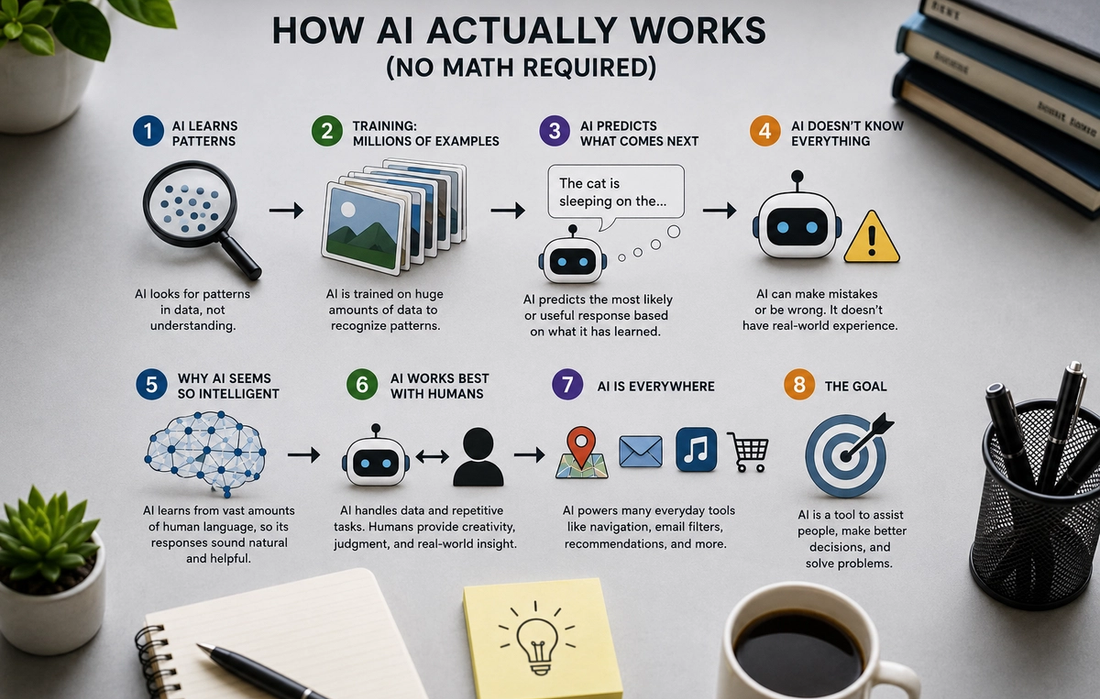
Artificial intelligence has quickly become part of everyday life. Whether you’re asking a chatbot a question, using a translation app, receiving personalized recommendations on a streaming platform, or editing photos with a single tap, chances are you’re already using AI more often than you realize.
Despite its growing presence, AI is still surrounded by confusion. Some people imagine it as a machine that thinks exactly like a human, while others believe it’s almost magical. In reality, artificial intelligence is neither. It’s a collection of technologies that allow computers to recognize patterns, make predictions, and generate responses based on enormous amounts of data.
The good news is that you don’t need to understand advanced mathematics or computer science to understand the basic idea behind AI. Once you know how it works at a high level, it becomes much easier to separate reality from science fiction.
AI learns from patterns, not understanding
One of the biggest misconceptions about AI is that it “thinks” the way humans do.
People learn through experience, emotions, common sense, and an understanding of the world around them. AI works differently. Instead of understanding concepts in the human sense, it identifies patterns in data.
Imagine showing a computer millions of photographs of cats and dogs. Over time, the system begins to recognize the visual patterns that usually appear in each type of image. It doesn’t know what a cat actually is, nor does it understand why people like pets. It simply becomes very good at recognizing the patterns that are commonly associated with cats and dogs.
The same principle applies to language, music, images, and many other forms of information. AI becomes useful because it can recognize patterns on a scale far beyond what any person could process manually.
Training is like giving AI millions of examples
Before an AI system can perform useful tasks, it needs to be trained.
Training involves exposing the model to enormous amounts of information so it can identify relationships and recurring patterns. For a language model, this might include books, articles, websites, and other publicly available text. For an image model, it may involve millions of pictures paired with descriptions.
Think of it as learning through examples.
A child doesn’t learn a language from reading a dictionary once. They hear words repeated in different situations until patterns begin to emerge. AI training follows a similar principle, although on a much larger scale and without human understanding.
The more diverse and carefully prepared the training data is, the better the AI usually becomes at recognizing patterns and generating useful responses.
AI predicts what comes next
Many modern AI systems work by making predictions.
When you type a message and your phone suggests the next word, it’s predicting which word is most likely to come next based on patterns it has learned.
Large language models work in a similar way, but on a much more advanced level. Instead of predicting just one word, they consider the entire conversation, the relationships between words, and the context of your request before generating a response.
Although the answers often feel conversational, the underlying process is still based on probabilities rather than human thought.
In simple terms, AI is constantly asking itself, “Based on everything I’ve learned, what is the most likely or useful response to generate next?”
AI doesn’t know everything
Because AI can produce detailed and confident answers, it’s easy to assume it always knows the correct information.
In reality, AI has important limitations.
It doesn’t possess personal experiences, emotions, or true understanding. It can make mistakes, misunderstand context, or generate incorrect information if the patterns it relies on are incomplete or misleading.
That’s why human judgment remains essential, especially when using AI for important decisions involving health, finance, legal matters, or scientific research.
AI is an incredibly powerful assistant, but it shouldn’t be treated as an infallible source of truth.
Why AI seems so intelligent
One reason AI feels remarkably human is because it has learned from enormous amounts of language created by people.
Books, articles, conversations, research papers, and websites contain countless examples of how humans explain ideas, ask questions, solve problems, and tell stories. By learning these patterns, AI becomes capable of producing responses that sound natural and coherent.
However, sounding intelligent isn’t the same as being conscious.
AI doesn’t have beliefs, intentions, or personal opinions. It generates responses based on statistical relationships within the data it has learned from, not from independent thought.
That’s an important distinction to remember whenever you interact with an AI system.
AI is already part of everyday life
Many people think of AI as futuristic technology, but it’s already quietly integrated into countless everyday tools.
Navigation apps use AI to predict traffic. Email services filter spam automatically. Streaming platforms recommend movies and music based on your interests. Banks use AI to detect unusual transactions, while smartphones rely on it for voice assistants, photography, and predictive text.
Increasingly, businesses are also using AI to summarize documents, assist with customer support, analyze data, and automate repetitive tasks.
As the technology continues improving, AI will likely become even more common—not as a replacement for people, but as a tool that helps people work more efficiently.
AI works best alongside humans
One of the most important things to understand about artificial intelligence is that it’s designed to assist rather than replace human thinking.
AI can process enormous amounts of information quickly, identify patterns, generate ideas, and automate repetitive work. Humans, however, bring qualities that machines don’t possess, including creativity, empathy, ethics, judgment, and real-world experience.
The strongest results often come from combining both.
When people use AI thoughtfully, it becomes a powerful partner that handles routine tasks while allowing humans to focus on critical thinking, decision-making, and creative problem-solving.
Understanding AI makes it less mysterious
Artificial intelligence can seem intimidating because it’s often described as something mysterious or almost magical. In reality, it’s built on surprisingly simple ideas. AI learns from patterns, trains on large amounts of data, and generates predictions based on what it has observed.
It doesn’t think like a person, experience emotions, or truly understand the world. Instead, it excels at recognizing relationships within information and using those patterns to produce useful outputs.
As AI becomes a larger part of everyday life, understanding these basics will become just as important as understanding how the internet works today. You don’t need to know the mathematics behind it to use it wisely—you simply need to understand what AI can do, what it can’t do, and why human judgment will always remain an essential part of the equation.


AI
How AI Actually Works (No Math Required)

How to Spot AI-Generated Content Even When It’s Good
The Real Difference Between AI, Machine Learning, and Deep Learning
How to Prompt AI Like a Pro








Read More

Why the World Feels Faster Than Ever (And What to Do About It)
Astrid Jensen|
Why Some People Notice More Than Others
Joel Anderson|

Why the Slow Things Are Quietly Winning
Brett Crane|

How to Spend Less Without Feeling Deprived
Joel Anderson|

How to Spend a Sunday Like You Mean It
Brett Crane|

The Inventions That Changed How We Live (And Why)
Karina Leon|