

How to Build a Morning Routine That Actually Sticks
A
By Astrid Jensen on July 2, 2026
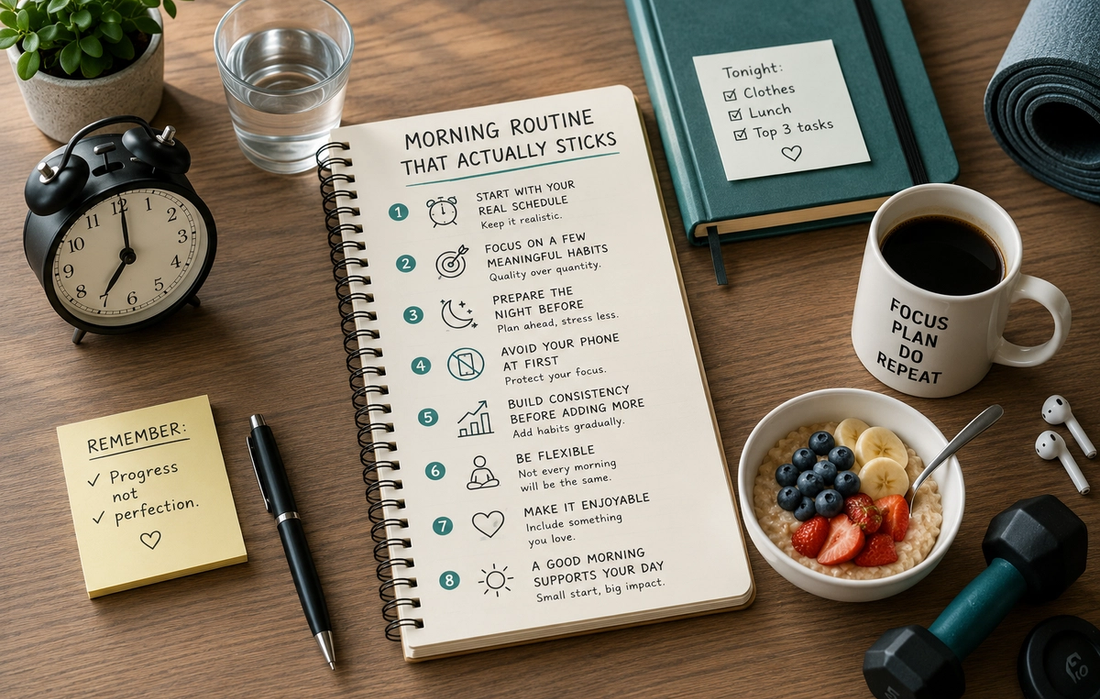
There’s something appealing about the idea of a perfect morning routine. We picture ourselves waking up early, exercising, meditating, journaling, reading, eating a healthy breakfast, and starting work feeling focused and energized. Social media is full of carefully curated morning schedules that make productivity look effortless.
The reality is usually very different.
Many ambitious routines last only a few days because they’re built around an ideal version of ourselves rather than our actual lives. We try to change everything at once, wake up much earlier than usual, and pack too many activities into the first hour of the day. Before long, the routine feels exhausting instead of motivating.
A morning routine doesn’t have to be complicated to be effective. In fact, the routines people stick with for years are usually the simplest ones. The goal isn’t to create the “perfect” morning—it’s to create one that supports your life consistently.
Start with your real schedule
One of the biggest mistakes people make is copying someone else’s routine without considering their own circumstances.
A business owner, a university student, a shift worker, and a parent with young children all have very different mornings. What works for one person may be unrealistic for another.
Before planning your routine, think about how much time you actually have and what your mornings usually look like. A realistic twenty-minute routine you’ll follow every day is far more valuable than a two-hour routine you’ll abandon after a week.
The best routines fit naturally into your life instead of forcing your life to revolve around them.
Focus on a few meaningful habits
A successful morning routine doesn’t need ten different activities.
Instead of trying to meditate, exercise, journal, read, listen to a podcast, prepare a perfect breakfast, and answer emails before 8 a.m., choose two or three habits that genuinely improve your day.
For some people, that might mean stretching for ten minutes, drinking a glass of water, and reviewing the day’s priorities. Others may prefer a short walk, a healthy breakfast, and a few quiet minutes before work begins.
The purpose of a morning routine isn’t to impress anyone. It’s to create a calm and intentional start to the day.
Prepare the night before
One of the easiest ways to make mornings less stressful is to reduce the number of decisions you have to make after waking up.
Simple preparations can make a noticeable difference. Lay out your clothes, prepare your lunch, organize your workspace, or write tomorrow’s most important task before going to bed.
These small actions create a smoother morning because you’re no longer trying to solve every problem while you’re still waking up.
Morning success often begins the evening before.
Avoid reaching for your phone immediately
For many people, checking their phone is the first thing they do after waking up.
Within minutes they’re reading emails, scrolling through social media, checking the news, or responding to messages. Before they’ve even gotten out of bed, their attention has already been pulled in multiple directions.
While there isn’t a single “correct” way to start the day, giving yourself even fifteen or twenty minutes before diving into notifications can make mornings feel noticeably calmer.
Using that time to wake up gradually, enjoy breakfast, stretch, or simply think about the day ahead allows you to begin with intention rather than reaction.
Build consistency before adding more
When building a new routine, it’s tempting to do everything at once.
A better strategy is to establish one habit first.
Perhaps you begin by waking up at the same time each weekday. Once that feels automatic, you might add a short walk or five minutes of reading. After that becomes consistent, you can introduce another small habit.
This gradual approach makes the routine much easier to maintain because you’re building on an existing foundation instead of trying to create an entirely new lifestyle overnight.
Consistency is far more important than complexity.
Accept that every morning will be different
Life is unpredictable.
Some mornings you’ll oversleep, your children may need extra attention, meetings may start earlier than expected, or unexpected responsibilities may interrupt your plans.
A flexible routine survives these situations much better than a rigid one.
Instead of believing the entire morning is ruined because you skipped one activity, simply complete whatever parts are still possible. Even spending five quiet minutes planning your day is better than abandoning the routine altogether.
The people who maintain morning habits for years aren’t perfect—they’re adaptable.
Make your routine something you enjoy
Many morning routines fail because they feel like a long list of obligations.
If every activity feels like work, it’s unlikely you’ll look forward to repeating it.
Try including at least one habit you genuinely enjoy. That could be making your favorite coffee, reading a few pages of a novel, listening to music, spending time outdoors, or eating breakfast without rushing.
Enjoyment increases consistency because it gives you something positive to associate with the routine.
Healthy habits don’t have to feel like punishment to be effective.
A good morning supports the rest of the day
A morning routine won’t solve every challenge you face, but it can influence how the rest of your day unfolds.
Starting with a few intentional habits often makes it easier to stay organized, make thoughtful decisions, and respond more calmly when unexpected situations arise. You begin the day feeling as though you’re directing your schedule instead of simply reacting to it.
That doesn’t require waking up at 5 a.m. or following an elaborate productivity system.
It simply requires creating a routine that reflects your priorities.
The best routine is the one you’ll still follow next month
It’s easy to become inspired by ambitious morning routines shared online, but lasting habits are rarely built through dramatic overnight changes.
They’re built through small actions repeated consistently until they become part of everyday life.
Whether your routine takes fifteen minutes or an hour matters far less than whether it helps you feel prepared for the day ahead. A realistic routine that fits your lifestyle will always outperform a perfect routine you can’t maintain.
Ultimately, building a morning routine that actually sticks isn’t about copying someone else’s schedule. It’s about designing one that works for you, supports your goals, and is simple enough to become a natural part of your daily life.

AI

How AI Actually Works (No Math Required)

How to Spot AI-Generated Content Even When It’s Good

The Real Difference Between AI, Machine Learning, and Deep Learning

How to Prompt AI Like a Pro






Read More

Why the World Feels Faster Than Ever (And What to Do About It)
Astrid Jensen|
Why Some People Notice More Than Others
Joel Anderson|

Why the Slow Things Are Quietly Winning
Brett Crane|

How to Spend Less Without Feeling Deprived
Joel Anderson|

How to Spend a Sunday Like You Mean It
Brett Crane|

The Inventions That Changed How We Live (And Why)
Karina Leon|