

How to Spot AI-Generated Content Even When It’s Good
A
By Astrid Jensen on July 2, 2026
Artificial intelligence has become remarkably good at writing. Blog posts, emails, product descriptions, social media captions, and even entire reports can now be generated in seconds. In many cases, the results are so polished that it’s impossible to know whether a human or an AI wrote them just by reading a few sentences.
That doesn’t mean AI-generated content is always deceptive or low quality. Many businesses and creators use AI as a legitimate writing assistant to brainstorm ideas, organize information, or draft content more efficiently. The challenge is that not every piece of AI-generated writing is carefully reviewed, and some articles still contain subtle signs that reveal how they were created.
As AI writing tools continue to improve, spotting AI-generated content is becoming more difficult. Instead of looking for one obvious clue, it’s better to pay attention to a combination of patterns.
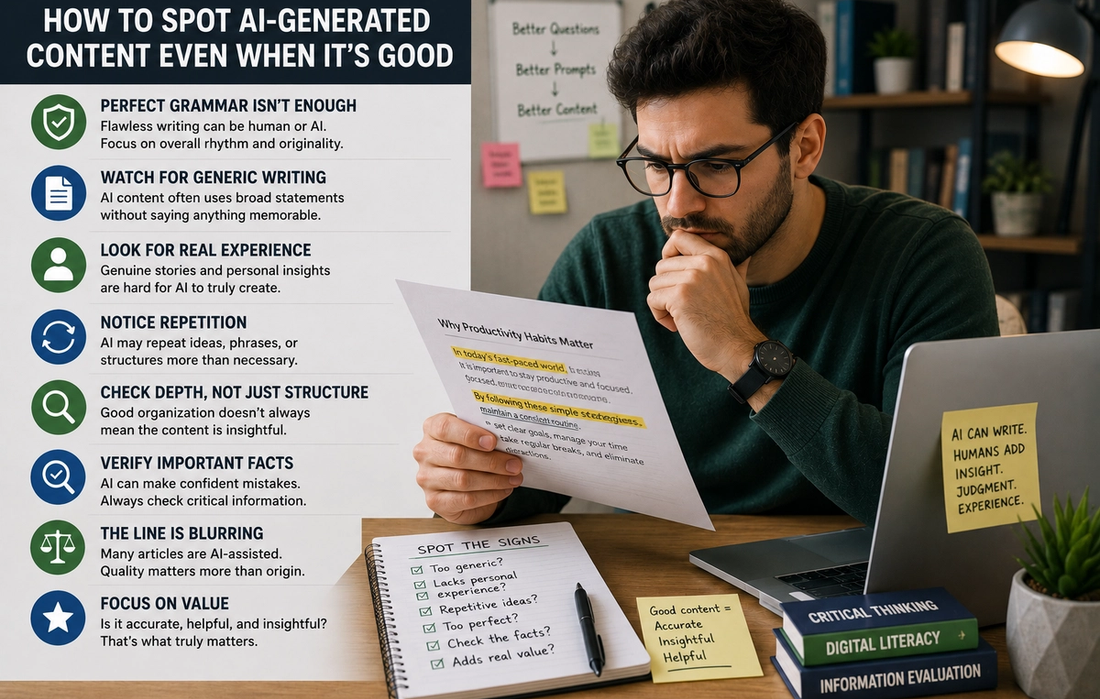
Perfect grammar doesn’t always mean human writing
One of the biggest myths is that flawless grammar automatically means something was written by AI. In reality, skilled human writers produce polished work too, and many AI-generated articles now include intentional variations to sound more natural.
Instead of focusing on grammar alone, pay attention to the overall rhythm of the writing. AI-generated content often feels consistently polished from beginning to end, with very few unexpected turns of phrase, personal observations, or moments of genuine individuality.
Human writers tend to have unique habits. They might use unusual examples, tell a short story, or phrase something in a way that’s distinctly their own. AI can imitate those techniques, but it often struggles to make them feel truly personal.
Watch for writing that feels generic
One of the most common characteristics of AI-generated content is that it sounds informative without saying anything especially memorable.
An article may explain a topic accurately while relying on broad statements that could apply almost anywhere. It may avoid taking a clear position, rarely include surprising insights, and move smoothly from one section to the next without offering much originality.
For example, a travel article might repeatedly describe places as “beautiful,” “vibrant,” or “worth visiting” without explaining what actually makes them unique. A productivity article might recommend setting goals and staying organized without offering practical examples or specific experiences.
Good human writing usually contains details that make it feel grounded rather than interchangeable.
Personal experience is difficult to fake
Readers naturally connect with stories.
A writer describing how they solved a difficult problem at work, learned a lesson from a failed project, or changed their opinion after a particular experience adds something that facts alone cannot provide.
AI can certainly generate fictional anecdotes, but unless it’s working from information provided by a human, it doesn’t have genuine personal experiences to draw from.
That doesn’t mean every article needs a personal story. However, consistently avoiding concrete examples or relying on vague anecdotes can sometimes be a sign that AI played a major role in creating the content.
Repetition can be a clue
AI models are trained to reinforce important ideas, which sometimes leads to subtle repetition.
You may notice the same message being expressed several different ways throughout an article. Certain phrases, sentence structures, or transitions may appear more often than necessary, making the writing feel slightly predictable.
A skilled editor can remove much of this repetition, but articles published without careful human review often repeat key points more than a human writer naturally would.
If you find yourself thinking, “Didn’t I already read this?” it’s worth taking a closer look.
Look for depth, not just structure
AI is very good at producing well-organized content.
Articles often have clear headings, logical flow, and easy-to-read formatting. Those qualities are valuable, but structure alone doesn’t guarantee quality.
Ask yourself whether each section adds something genuinely new or simply restates ideas you’ve already encountered. Strong human writing often includes deeper analysis, unexpected connections, or fresh perspectives that go beyond summarizing common knowledge.
An article that is perfectly structured but surprisingly shallow may have relied heavily on AI.
Check facts when accuracy matters
One area where AI still requires human oversight is factual accuracy.
Modern AI systems can summarize information extremely well, but they can also make mistakes, confuse details, or present outdated information with confidence. This is especially important for topics involving health, finance, science, or current events.
Whenever an article includes statistics, historical claims, or technical advice, it’s worth checking whether credible sources support those statements.
Reliable human writers—and responsible AI users—verify important facts before publishing.
The line between human and AI is becoming blurry
It’s important to remember that many articles today are created through collaboration.
A writer may use AI to brainstorm ideas, generate an outline, or improve awkward sentences before editing the draft extensively. In those cases, asking whether the article is “human” or “AI” misses the point.
The more useful question is whether the content is accurate, thoughtful, and genuinely helpful.
Well-edited AI-assisted writing can be excellent, just as entirely human-written content can sometimes be rushed or poorly researched.
The quality of the final result matters more than the tool used to create it.
Focus on value rather than guessing
As AI writing continues to improve, identifying it with complete certainty will become increasingly difficult. There is no single phrase, sentence pattern, or writing style that proves a piece of content was generated by artificial intelligence.
Instead of trying to play detective every time you read an article, focus on what truly matters. Is the information accurate? Does the writer provide meaningful insights? Are claims supported by evidence? Did you learn something useful?
The best content—whether written entirely by a person or created with the help of AI—is thoughtful, reliable, engaging, and valuable to the reader.
In the years ahead, the distinction between human writing and AI-assisted writing will likely become less important than the quality of the ideas being shared. The writers who stand out won’t simply be the ones who avoid AI; they’ll be the ones who combine good judgment, careful editing, and genuine expertise to create content worth reading.


AI
How AI Actually Works (No Math Required)

How to Spot AI-Generated Content Even When It’s Good

The Real Difference Between AI, Machine Learning, and Deep Learning

How to Prompt AI Like a Pro








Read More

Why the World Feels Faster Than Ever (And What to Do About It)
Astrid Jensen|
Why Some People Notice More Than Others
Joel Anderson|

Why the Slow Things Are Quietly Winning
Brett Crane|

How to Spend Less Without Feeling Deprived
Joel Anderson|

How to Spend a Sunday Like You Mean It
Brett Crane|

The Inventions That Changed How We Live (And Why)
Karina Leon|