

Why Some People Notice More Than Others
J
By Joel Anderson on July 2, 2026
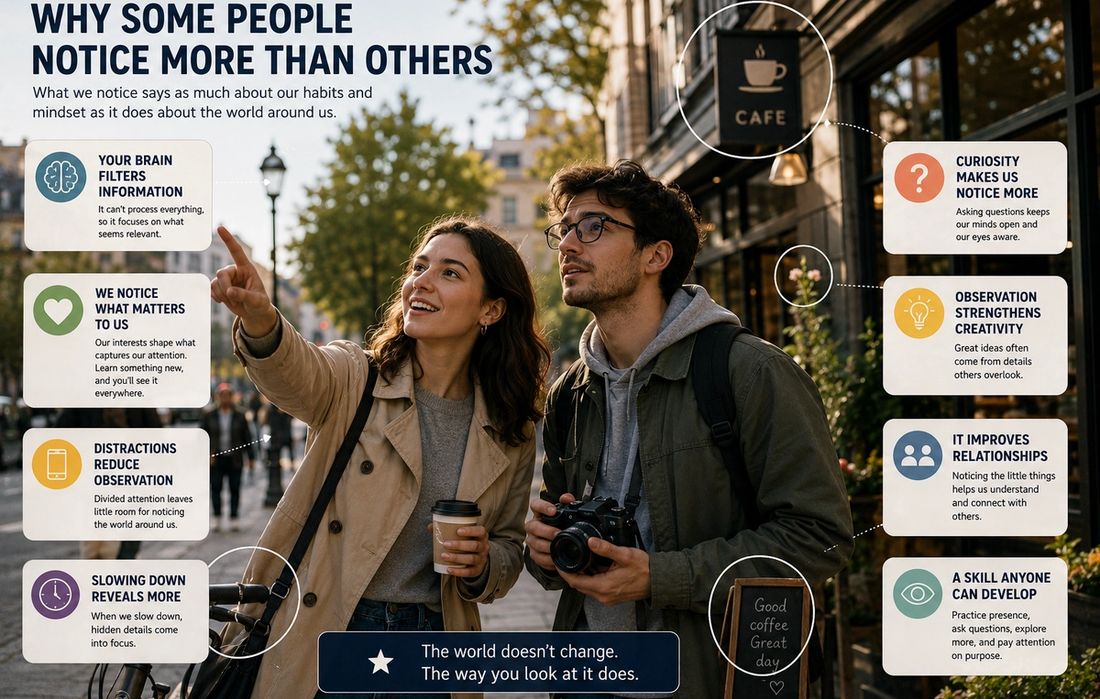
Have you ever walked through the same street as someone else only to hear them point out details you completely missed? They notice the new café opening on the corner, the unusual architecture of a building, the expression on someone’s face, or the first flowers beginning to bloom in a nearby park. Meanwhile, you wonder how you walked past the exact same places without seeing any of it.
The difference isn’t necessarily that they have better eyesight or a naturally superior memory. More often, they pay attention differently.
Our brains are constantly filtering information. Every second, we receive far more sights, sounds, smells, and sensations than we could ever consciously process. To avoid becoming overwhelmed, the brain decides what deserves our attention and quietly ignores the rest.
This means that what we notice says as much about our habits and mindset as it does about the world around us.
Your brain can’t notice everything
Although it may feel as though we’re aware of everything happening around us, that’s far from reality.
At any given moment, your brain is receiving an enormous amount of sensory information. If it processed every detail equally, everyday life would become overwhelming. Instead, it acts as a filter, selecting the information that seems most relevant while allowing everything else to fade into the background.
This filtering process helps us function efficiently, but it also explains why two people can experience the exact same event and remember it very differently.
Each person’s attention is guided by their own experiences, interests, expectations, and goals.
We notice what matters to us
One reason people observe different things is that our interests shape what captures our attention.
A photographer may immediately notice interesting lighting, while an architect pays attention to building design. A parent might spot a playground before anyone else, and a gardener may notice flowers that others walk past without a second glance.
Our brains naturally become more sensitive to information connected to things we care about.
This is why learning something new often changes how you experience the world. Once you’ve developed an interest in birds, astronomy, interior design, or classic cars, you suddenly begin noticing examples everywhere.
The world hasn’t changed—you’ve simply trained your attention to recognize new patterns.
Modern distractions reduce observation
Many people move through daily life while their attention is focused somewhere else.
Walking while reading messages, eating while watching videos, or waiting in line while scrolling through social media leaves very little mental space to notice the environment around us.
As a result, entire days can pass without us remembering much about them.
People who appear especially observant often have one habit in common: they’re more present.
Instead of dividing their attention between multiple screens and tasks, they allow themselves to fully engage with what’s happening around them.
Presence creates awareness.
Curiosity makes people notice more
Curiosity is one of the strongest drivers of observation.
People who ask questions naturally pay closer attention because they’re actively looking for answers. They wonder why something works the way it does, why people behave in certain ways, or how a particular place came to look the way it does.
Rather than moving through life on autopilot, curious people treat ordinary situations as opportunities to learn.
This mindset encourages them to notice details that others might overlook simply because they’re paying closer attention.
Curiosity turns everyday experiences into opportunities for discovery.
Slowing down reveals hidden details
Many details disappear simply because we’re moving too quickly.
When rushing between meetings, errands, or appointments, our attention narrows to the task directly in front of us. Efficiency becomes the priority, leaving little room for observation.
Slowing down—even slightly—often changes what we notice.
A short walk without headphones, sitting quietly in a café, or taking a different route home can reveal things that were always there but rarely received our attention.
The world often feels richer when we stop rushing through it.
Observation strengthens creativity
Many creative ideas begin with careful observation rather than sudden inspiration.
Writers notice conversations and human behavior. Designers pay attention to how people use products. Entrepreneurs observe everyday frustrations that others have simply accepted. Scientists notice patterns that lead to new discoveries.
Creativity often comes from connecting observations that other people overlooked.
The more carefully you observe the world, the more raw material your mind has for generating new ideas.
This is one reason curiosity and creativity are so closely connected.
Observation improves relationships
Paying attention isn’t only useful for noticing places or objects.
It also helps us understand people.
Observant individuals often notice changes in someone’s mood, recognize when a friend seems unusually quiet, remember small details from previous conversations, or sense when someone needs support before they ask for it.
These observations strengthen relationships because they make people feel seen and valued.
Listening carefully, remembering details, and being fully present during conversations are all forms of paying attention that have little to do with intelligence and everything to do with intention.
Observation is a skill anyone can develop
It’s easy to assume that some people are simply born more observant than others.
While natural differences certainly exist, observation is largely a skill that improves with practice.
Looking up from your phone more often, asking questions, exploring unfamiliar places, reading widely, spending time in nature, and intentionally slowing down all strengthen your ability to notice the world around you.
Over time, these habits gradually change how you experience everyday life.
You begin seeing opportunities, patterns, and moments of beauty that once passed unnoticed.
The world becomes richer when you pay attention
Life isn’t only shaped by the places we visit or the experiences we have. It’s also shaped by what we notice while we’re there.
The same street can appear ordinary to one person and fascinating to another. The difference often isn’t the environment itself—it’s the quality of attention being given to it.
In a world filled with distractions, the ability to notice has become increasingly valuable. It deepens conversations, strengthens relationships, fuels creativity, and makes ordinary moments feel more meaningful.
Perhaps that’s why the most observant people often seem to experience life differently. They aren’t living in another world.
They’re simply paying closer attention to the one that’s already in front of them.


AI

How AI Actually Works (No Math Required)

How to Spot AI-Generated Content Even When It’s Good

The Real Difference Between AI, Machine Learning, and Deep Learning

How to Prompt AI Like a Pro







Read More

Why the World Feels Faster Than Ever (And What to Do About It)
Astrid Jensen|
Why Some People Notice More Than Others
Joel Anderson|

Why the Slow Things Are Quietly Winning
Brett Crane|

How to Spend Less Without Feeling Deprived
Joel Anderson|

How to Spend a Sunday Like You Mean It
Brett Crane|

The Inventions That Changed How We Live (And Why)
Karina Leon|