
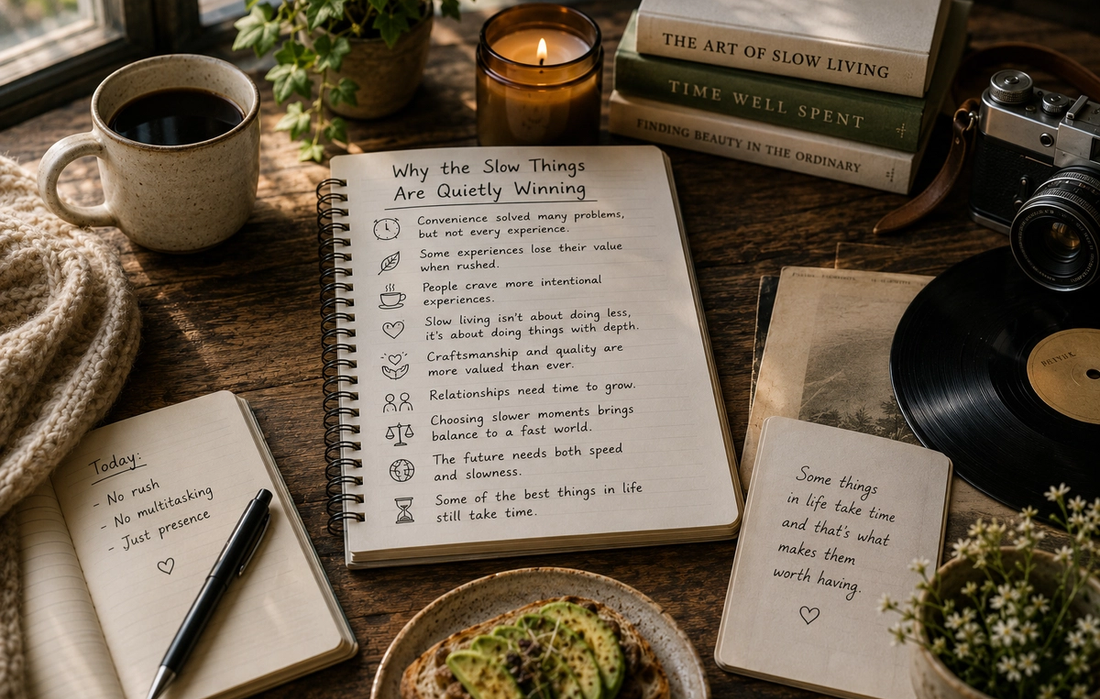
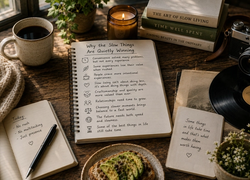
Why the Slow Things Are Quietly Winning
B
By Brett Crane on July 2, 2026
For years, modern culture celebrated speed above almost everything else.
Faster internet, faster deliveries, faster replies, faster careers, and faster ways to learn, shop, travel, and communicate became symbols of progress. Convenience transformed everyday life, allowing us to accomplish in minutes what once took hours or even days. There is no doubt that these advances have improved many aspects of how we live.
At the same time, something unexpected has begun to happen.
Alongside our increasingly fast world, there is a growing appreciation for experiences that cannot be rushed. Independent bookstores are attracting loyal communities. People are rediscovering cooking at home, spending weekends hiking, buying vinyl records, writing in paper journals, and choosing long conversations over endless messaging. These slower experiences are not becoming popular because they’re more efficient. They’re becoming popular because they offer something speed often cannot: depth.
The quiet return of slower living suggests that, in some parts of life, faster isn’t always better.
Convenience solved many problems
It’s important to recognize that speed has brought enormous benefits.
Ordering medicine online, navigating unfamiliar cities with a smartphone, working remotely, accessing educational resources instantly, and communicating across continents have made everyday life easier and more accessible for millions of people.
Efficiency allows businesses to operate more effectively, reduces unnecessary waiting, and gives people more flexibility in how they spend their time.
The goal isn’t to reject modern technology or pretend life was better when everything took longer.
The question is whether every experience actually benefits from becoming faster.
Some experiences lose their value when rushed
Not everything meaningful can be accelerated.
Friendships deepen through shared experiences over time. Trust develops gradually. Learning a difficult skill requires practice. A great meal often takes time to prepare, and a memorable holiday is rarely improved by trying to fit as many attractions as possible into a single day.
Even reading a novel, listening to an album from beginning to end, or taking a long walk encourages a different pace of thinking than constantly moving from one task to another.
Many of life’s richest experiences depend not on speed, but on presence.
People are craving more intentional experiences
One reason slower activities are becoming more popular is that they offer a break from constant stimulation.
After spending much of the day looking at screens, responding to notifications, and consuming endless streams of information, many people find themselves seeking experiences that demand their full attention instead.
Gardening, baking, painting, hiking, woodworking, knitting, reading, and other hands-on activities encourage patience. They don’t provide instant rewards, yet they often leave people feeling calmer and more fulfilled.
The value comes not only from the finished result but from the experience of slowing down while creating it.
Slow living isn’t about doing less
The phrase “slow living” sometimes creates the impression that people should become less ambitious or less productive.
In reality, it’s less about doing fewer things and more about doing them with greater intention.
Instead of eating while answering emails, you enjoy a meal without distractions. Instead of rushing through conversations, you listen carefully. Instead of filling every free moment with another task, you allow yourself time to think.
Slowing down doesn’t necessarily reduce achievement.
Often, it improves the quality of both the work we produce and the experiences we enjoy.
Craftsmanship is becoming more valuable
As mass production and automation become increasingly common, handmade products and carefully crafted experiences are attracting renewed appreciation.
People are willing to pay more for locally roasted coffee, handmade furniture, artisan bread, independent bookstores, and products created with exceptional attention to detail.
Part of their appeal lies in the time invested.
Knowing that something was carefully designed, built, or prepared by another person creates a sense of authenticity that mass-produced alternatives sometimes struggle to replicate.
In many industries, quality is quietly becoming a stronger competitive advantage than speed alone.
Relationships need time to grow
Perhaps nowhere is slowness more valuable than in human relationships.
Meaningful friendships, strong families, and lasting partnerships aren’t built through quick messages or occasional updates. They develop through shared experiences, conversations, patience, and consistent attention over months and years.
Modern communication makes staying in touch easier than ever, but genuine closeness still depends on spending quality time together.
Some things simply cannot be rushed.
Trust, understanding, and emotional connection are among them.
Choosing slower moments is a form of balance
Living more slowly doesn’t require abandoning technology or moving to the countryside.
It often begins with surprisingly ordinary choices.
Reading before bed instead of scrolling through social media. Cooking dinner instead of ordering takeaway every night. Walking to a nearby café instead of driving. Taking photographs without immediately posting them online. Spending an afternoon with friends without constantly checking notifications.
These small decisions don’t reject modern life.
They simply create moments where speed no longer dictates the experience.
The future may need both speed and slowness
Technology will almost certainly continue making life faster.
Artificial intelligence, automation, and digital services will save even more time in the years ahead. That’s something to celebrate, provided we use those efficiencies wisely.
Perhaps the greatest opportunity isn’t filling every saved minute with more work.
It’s using some of that time for the things that cannot be automated or accelerated—conversation, creativity, learning, reflection, family, friendship, and rest.
Ironically, the faster technology becomes, the more valuable these slower experiences may become.
Some of the best things in life still take time
The world will continue rewarding speed in many areas, and rightly so. Faster medical treatments, quicker emergency services, efficient transportation, and better technology improve countless lives every day.
But not everything should be measured by how quickly it happens.
Some of life’s greatest rewards grow slowly. Strong relationships, meaningful work, personal growth, wisdom, creativity, and unforgettable memories all require patience in ways that no algorithm can replace.
Perhaps that’s why slower experiences are quietly making a comeback. In a world that constantly encourages us to move faster, choosing to slow down has become something surprisingly rare.
And sometimes, the things that take the longest are the ones that stay with us the longest.
AI
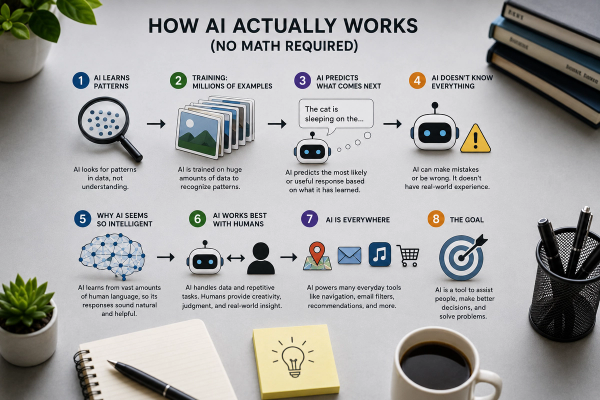
How AI Actually Works (No Math Required)

How to Spot AI-Generated Content Even When It’s Good

The Real Difference Between AI, Machine Learning, and Deep Learning

How to Prompt AI Like a Pro






Read More
Why the World Feels Faster Than Ever (And What to Do About It)
Astrid Jensen|
Why Some People Notice More Than Others
Joel Anderson|
Why the Slow Things Are Quietly Winning
Brett Crane|
How to Spend Less Without Feeling Deprived
Joel Anderson|
How to Spend a Sunday Like You Mean It
Brett Crane|
The Inventions That Changed How We Live (And Why)
Karina Leon|