

The Real Difference Between AI, Machine Learning, and Deep Learning
J
By Jessica Stuart on July 2, 2026
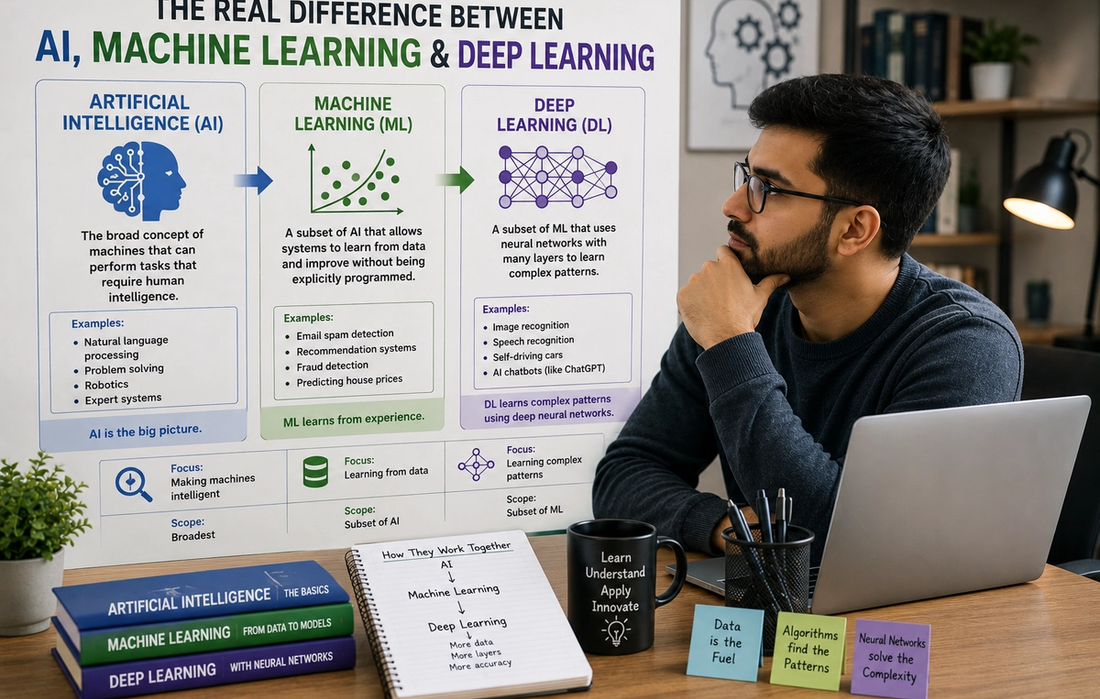
Artificial intelligence has become one of the most talked-about technologies in the world. Hardly a day goes by without headlines about AI chatbots, self-driving cars, medical breakthroughs, or new tools that promise to transform the way we work. Alongside these discussions, two other terms appear just as frequently: machine learning and deep learning.
Because these phrases are often used interchangeably, many people assume they all mean the same thing. In reality, they describe different concepts that are closely related but not identical. Understanding the difference doesn’t require a background in computer science. Once you see how they fit together, the terminology becomes much less confusing.
The simplest way to think about it is that artificial intelligence is the broad field, machine learning is one approach to building AI systems, and deep learning is a specialized type of machine learning.
Artificial intelligence is the big picture
Artificial intelligence, or AI, is the broad concept of creating computer systems that can perform tasks typically associated with human intelligence.
These tasks might include understanding language, recognizing images, translating text, playing games, solving problems, or making recommendations. The idea of AI has existed for decades, long before today’s chatbots and image generators became popular.
Importantly, AI doesn’t describe one specific technology. It’s an umbrella term that includes many different methods for making computers behave in ways that appear intelligent.
Some AI systems rely on simple rules programmed by humans, while others learn from enormous amounts of data. What they have in common is their goal: helping computers perform tasks that once required human thinking.
Machine learning teaches computers through experience
Machine learning is one of the most common ways to build AI systems today.
Instead of programming every possible rule by hand, developers allow the computer to learn patterns from data. The more examples the system processes, the better it becomes at recognizing relationships and making predictions.
Imagine trying to teach a computer to identify pictures of cats.
Using traditional programming, you would need to explain exactly what a cat looks like by defining countless rules about ears, whiskers, eyes, fur, and body shape. That quickly becomes impossible because every cat looks slightly different.
With machine learning, you simply provide the computer with thousands—or even millions—of labeled images of cats and other animals. By analyzing those examples, the system gradually learns the patterns that distinguish cats from everything else.
Rather than following fixed instructions, it improves by learning from experience.
Deep learning takes machine learning further
Deep learning is a more advanced form of machine learning inspired by the way the human brain processes information.
Instead of relying on simpler pattern recognition techniques, deep learning uses structures called neural networks, which contain many interconnected layers that analyze information step by step.
Each layer identifies increasingly complex features.
For example, when recognizing a face in a photograph, the first layer may detect simple edges and shapes. The next identifies eyes, noses, and mouths. Later layers combine those features to recognize an entire face.
Because deep learning systems can automatically discover highly complex patterns, they’ve driven many of the biggest AI breakthroughs in recent years.
Voice assistants, facial recognition, language translation, image generation, and modern AI chatbots all rely heavily on deep learning.
Why deep learning became so important
Although the idea of deep learning has existed for decades, it only became practical in recent years.
Three major developments made this possible.
First, computers became dramatically more powerful, allowing them to process enormous amounts of information much faster than before.
Second, the internet created access to vast amounts of training data, including text, images, audio, and video.
Finally, improvements in algorithms made neural networks more accurate and efficient than earlier approaches.
Together, these advances allowed deep learning systems to achieve levels of performance that previously seemed impossible.
Every technology has different strengths
Artificial intelligence, machine learning, and deep learning each have situations where they work best.
Traditional AI systems based on predefined rules can be highly reliable for straightforward tasks with clear instructions.
Machine learning performs well when large amounts of structured data are available and patterns need to be identified, such as detecting fraud or recommending products.
Deep learning excels at handling complex information like speech, photographs, natural language, and video, where manually defining every rule would be nearly impossible.
Choosing the right approach depends on the problem being solved rather than assuming one method is always better than another.
Why the terms are often confused
Part of the confusion comes from the way these technologies are discussed in the media.
Many news articles use “AI” as a catch-all term, even when they’re specifically describing machine learning or deep learning.
That’s not entirely wrong because both machine learning and deep learning are forms of AI. However, it’s similar to calling every vehicle a car. While cars are vehicles, not every vehicle is a car.
Understanding the relationship makes conversations about AI much easier to follow.
Whenever you hear someone mention machine learning or deep learning, remember that they’re talking about specific techniques within the broader field of artificial intelligence.
AI will continue to evolve
Artificial intelligence is advancing rapidly, but it’s important to remember that today’s systems remain specialized.
An AI model that writes text can’t automatically drive a car. A system trained to recognize medical images can’t suddenly become a language translator without additional training.
Researchers continue working toward more flexible and capable AI systems, but modern AI still relies heavily on learning patterns from enormous amounts of data rather than understanding the world the way humans do.
As technology continues improving, machine learning and deep learning will almost certainly remain central to many future innovations.
Understanding the bigger picture
Artificial intelligence, machine learning, and deep learning are closely connected, but they aren’t interchangeable.
Artificial intelligence is the broad goal of building systems that perform tasks requiring human-like intelligence. Machine learning is one of the primary methods used to achieve that goal by allowing computers to learn from data. Deep learning is a more advanced branch of machine learning that uses large neural networks to solve especially complex problems.
Understanding these differences doesn’t just make technology headlines easier to follow. It also provides a clearer picture of how many of today’s most impressive digital tools actually work.
The more familiar these concepts become, the easier it is to appreciate both the remarkable progress AI has made and the challenges that still lie ahead.


AI
How AI Actually Works (No Math Required)

How to Spot AI-Generated Content Even When It’s Good
The Real Difference Between AI, Machine Learning, and Deep Learning

How to Prompt AI Like a Pro








Read More

Why the World Feels Faster Than Ever (And What to Do About It)
Astrid Jensen|
Why Some People Notice More Than Others
Joel Anderson|

Why the Slow Things Are Quietly Winning
Brett Crane|

How to Spend Less Without Feeling Deprived
Joel Anderson|

How to Spend a Sunday Like You Mean It
Brett Crane|

The Inventions That Changed How We Live (And Why)
Karina Leon|