
The Inventions That Changed How We Live (And Why)
K
By Karina Leon on July 2, 2026
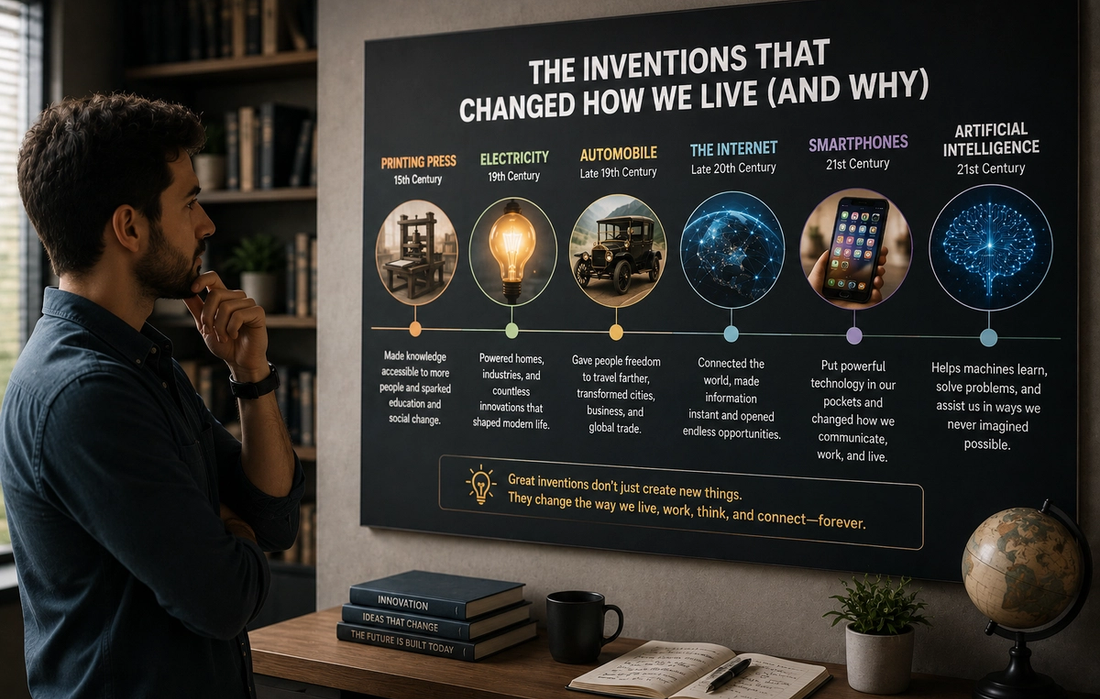
History is often remembered through major events, influential leaders, and groundbreaking discoveries. Yet some of the greatest changes in human civilization have come from inventions that quietly transformed everyday life. Many of these innovations didn’t simply make existing tasks easier—they changed the way people worked, traveled, communicated, learned, and interacted with the world.
Some inventions were so successful that it’s difficult to imagine life before they existed. We rarely stop to think about electricity when we switch on a light or the internet when we send a message across the world. These technologies have become so deeply integrated into modern life that they feel ordinary, even though they once represented extraordinary breakthroughs.
Looking back at these inventions reminds us that progress isn’t always driven by one dramatic moment. More often, it happens through ideas that gradually reshape society until they become indispensable.
The printing press made knowledge accessible
Before the invention of the printing press in the fifteenth century, books were copied by hand, making them expensive, rare, and available to only a small portion of the population. Knowledge spread slowly, and education was largely limited to those who had access to handwritten manuscripts.
The printing press changed that completely. Books could be produced far more quickly and at a much lower cost, allowing ideas to travel across countries and generations. Literacy increased, scientific discoveries spread more rapidly, and education became accessible to many more people.
Its influence extended far beyond publishing. By making information easier to share, the printing press helped fuel cultural movements, scientific progress, and social change that shaped the modern world.
Electricity transformed everyday life
Few inventions have influenced daily life as profoundly as the widespread use of electricity.
Before electric power became common, homes relied on candles and oil lamps for light, industries depended on steam or manual labor, and many everyday tasks required significantly more time and effort.
Electricity made possible countless innovations that followed, including household appliances, refrigeration, modern healthcare equipment, computers, telecommunications, and public transportation systems.
Rather than being a single invention, electricity became the foundation upon which much of modern technology was built. Today, it powers almost every aspect of our personal and professional lives.
The automobile changed how we move
The invention of the automobile fundamentally changed the relationship between people and distance.
Travel that once took days by horse or train became possible in a matter of hours. Families gained greater freedom to live farther from where they worked, businesses expanded their reach, and entirely new industries emerged around manufacturing, fuel, roads, tourism, and logistics.
Cars also transformed cities, influencing how neighborhoods were designed and how goods were transported across countries.
Although transportation continues evolving through electric vehicles and autonomous driving technology, the automobile remains one of the inventions that reshaped modern society more than almost any other.
The internet connected the world
The internet has arguably become one of the most influential inventions of the modern era.
What began as a way to connect computers has evolved into a global network that supports communication, education, commerce, entertainment, healthcare, research, and business. Today, billions of people can instantly access information, collaborate across continents, and share ideas in ways previous generations could scarcely imagine.
The internet has also transformed industries by enabling online shopping, remote work, digital banking, video streaming, cloud computing, and social media.
Its greatest achievement may not be the technology itself but the way it has made knowledge and communication available to people almost everywhere.
Smartphones put powerful technology in our pockets
Not long ago, carrying separate devices for photography, navigation, music, communication, and internet access was perfectly normal.
Today, a single smartphone combines all of those functions and many more.
Modern smartphones have changed how we organize our lives, consume information, shop, learn new skills, manage finances, and stay connected with family and friends. They have also become powerful tools for creativity, allowing people to produce professional-quality photos, videos, and written content from almost anywhere.
While smartphones have introduced new challenges related to screen time and digital wellbeing, their impact on daily life is undeniable.
Artificial intelligence is changing how we work
Artificial intelligence is quickly becoming one of the defining technologies of the twenty-first century.
Unlike earlier inventions that focused mainly on physical tasks, AI is increasingly assisting with cognitive work. It can summarize information, generate ideas, translate languages, recognize patterns, automate repetitive processes, and support decision-making across countless industries.
Rather than replacing human intelligence, AI is often most valuable when working alongside people. It handles routine tasks quickly, allowing humans to focus on creativity, critical thinking, and complex problem-solving.
As AI continues to develop, its influence is likely to expand in much the same way the internet did over the past few decades.
Great inventions create ripple effects
One reason certain inventions become so influential is that they enable countless other innovations.
Electricity made computers possible. Computers helped create the internet. The internet accelerated the development of smartphones. Smartphones now provide access to artificial intelligence in the palm of your hand.
Innovation rarely happens in isolation. Each breakthrough builds on the discoveries that came before it, creating a chain of progress that continues across generations.
This is why even relatively small inventions can eventually lead to enormous changes when combined with other technologies.
The next great invention may already be taking shape
History teaches us that it’s often difficult to recognize the full importance of an invention while it’s still new.
The first automobiles were viewed as curiosities. Early computers filled entire rooms and seemed relevant only to specialists. Few people imagined the internet becoming central to everyday life.
Today’s emerging technologies—from renewable energy and biotechnology to robotics and artificial intelligence—may eventually reshape society just as profoundly.
Some of the inventions that future generations consider essential are likely being developed right now.
Innovation has always moved humanity forward
The inventions that changed the world didn’t simply introduce new products. They changed how people lived, worked, learned, and connected with one another.
Whether it was the printing press making knowledge more accessible, electricity powering modern civilization, the automobile transforming travel, the internet connecting billions of people, or AI beginning to reshape the workplace, each breakthrough expanded what humanity believed was possible.
While no one can predict the future with certainty, history suggests one thing remains constant: innovation never truly stops. Every generation builds upon the ideas of those who came before, creating technologies that eventually become so familiar we can hardly imagine life without them.
The next invention that changes the world may not arrive with great fanfare. Like many of history’s greatest breakthroughs, it may simply begin as one good idea that solves a problem in a better way.


AI
How AI Actually Works (No Math Required)

How to Spot AI-Generated Content Even When It’s Good
The Real Difference Between AI, Machine Learning, and Deep Learning

How to Prompt AI Like a Pro







Read More

Why the World Feels Faster Than Ever (And What to Do About It)
Astrid Jensen|
Why Some People Notice More Than Others
Joel Anderson|

Why the Slow Things Are Quietly Winning
Brett Crane|

How to Spend Less Without Feeling Deprived
Joel Anderson|

How to Spend a Sunday Like You Mean It
Brett Crane|
The Inventions That Changed How We Live (And Why)
Karina Leon|