
Why the World Feels Faster Than Ever (And What to Do About It)
A
By Astrid Jensen on July 2, 2026
Many people share the same feeling: life seems to be moving faster than it used to.
Weeks disappear before we realize it. Emails arrive faster than we can answer them. News updates never stop, our phones constantly demand attention, and even our free time often feels scheduled. It’s common to end the day wondering where the hours went or to reach the end of the year feeling as though it passed in the blink of an eye.
While the world hasn’t literally sped up, the way we experience time has changed. Advances in technology, constant access to information, and increasingly busy lifestyles have created an environment where everything feels more immediate than ever before.
The encouraging news is that although we can’t slow down time itself, we can change the way we experience it.
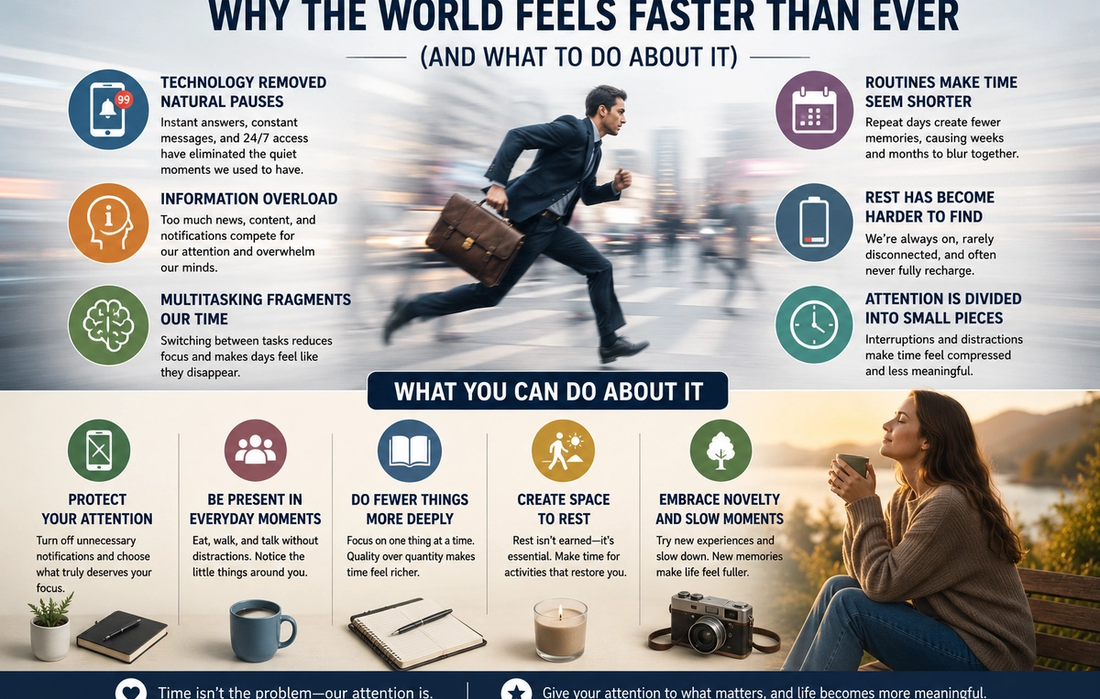
Technology has removed many natural pauses
Not long ago, everyday life contained built-in moments of waiting.
People waited for letters to arrive, visited libraries to find information, developed photographs before seeing them, and often had uninterrupted periods without communication. Those pauses created natural opportunities to reflect, rest, or simply be present.
Today, many of those moments have disappeared.
Questions are answered instantly through search engines. Messages arrive within seconds. Entertainment is available whenever we want it. News updates continue around the clock, and work often follows us through our phones long after office hours have ended.
Convenience has undoubtedly improved many aspects of life, but it has also reduced the quiet spaces where our minds once had a chance to slow down.
Constant information creates mental overload
Every day, we process an extraordinary amount of information.
Emails, notifications, headlines, videos, podcasts, advertisements, social media posts, and endless conversations compete for our attention from morning until night. Our brains weren’t designed to focus on so many different inputs simultaneously.
As attention shifts rapidly from one thing to another, time can begin to feel compressed. Entire days disappear into a series of small interruptions without any single moment feeling particularly memorable.
When every hour contains dozens of competing demands, it’s easy to feel busy without feeling fulfilled.
Sometimes what feels like “time moving faster” is actually our attention being divided into smaller and smaller pieces.
Multitasking makes time feel fragmented
Many people pride themselves on multitasking.
We answer emails during meetings, check messages while watching television, scroll through social media while eating dinner, and think about tomorrow’s responsibilities while trying to enjoy today.
Although it may feel productive, research consistently suggests that constantly switching between tasks reduces concentration and increases mental fatigue.
More importantly, fragmented attention often makes experiences feel less meaningful. When we’re never fully present, our memories become less vivid, making time seem as though it passed more quickly than it actually did.
Doing fewer things with greater attention can often make life feel richer rather than slower.
Routines make time seem shorter
As we get older, life often becomes more predictable.
Work, household responsibilities, commuting, and recurring commitments create routines that require relatively little conscious thought. While routines help us function efficiently, they can also influence how we perceive time.
When days become highly repetitive, our brains create fewer distinct memories. Looking back, weeks or months can seem to blur together because there are fewer memorable experiences separating them.
Trying something new—a weekend trip, a different walking route, learning a skill, or meeting new people—creates stronger memories and often makes time feel fuller in retrospect.
Novelty has a remarkable effect on how we experience the passage of time.
Rest has become harder to find
Many people are technically off work but never truly disconnected.
Notifications continue arriving during evenings, social media fills quiet moments, and the temptation to check one more email or complete one more task makes genuine rest increasingly difficult.
Without periods of recovery, life begins to feel like one continuous stream of activity.
Rest isn’t simply the absence of work. It’s the presence of activities that allow your mind and body to recover—reading, spending time outdoors, having uninterrupted conversations, exercising, or simply sitting quietly without feeling the need to be constantly occupied.
Protecting these moments is becoming increasingly important in a fast-moving world.
Slow moments deserve more attention
One of the simplest ways to change your experience of time is to become more present during ordinary moments.
Eating without looking at your phone. Taking a walk without headphones. Having coffee with a friend without checking notifications. Watching the sunset instead of photographing it immediately.
These moments may seem small, but they create memories that make life feel richer and more meaningful.
When we’re fully present, we often notice details that would otherwise disappear in the rush of daily life.
Attention is one of the few things that can genuinely change how we experience time.
You don’t have to keep up with everything
Modern culture often creates the impression that we should know every news story, reply to every message immediately, follow every trend, and remain constantly available.
In reality, that’s impossible.
Trying to keep up with everything often leaves us feeling behind no matter how much we accomplish.
Accepting that you don’t need to consume every piece of information or respond instantly to every notification can be surprisingly freeing. Choosing what deserves your attention allows you to focus on what actually adds value instead of constantly reacting to whatever appears next.
Sometimes slowing down begins with giving yourself permission not to keep pace with everything around you.
A slower life begins with intentional choices
The world will probably continue becoming faster.
Technology will improve, information will become even more accessible, and daily life will continue evolving. We can’t control those changes, but we can decide how we respond to them.
Choosing to protect your attention, create moments without screens, prioritize meaningful relationships, and make time for genuine rest won’t stop the clock. What it can do is change how your days feel.
Instead of rushing from one task to the next, you begin experiencing life more fully.
Time isn’t the problem—our attention is
It’s easy to believe that time itself is moving faster than it once did. More often, the real change is how we spend our attention.
When every moment is filled with distractions, interruptions, and constant stimulation, days blend together and life can begin to feel like it’s passing us by. But when we slow down enough to notice the people around us, appreciate ordinary moments, and focus on one thing at a time, our experience of time changes.
Life becomes less about racing through endless tasks and more about being present for the moments that matter.
The world may continue moving at an incredible pace, but you don’t have to experience every day as a race. Sometimes the most meaningful way to reclaim your time isn’t by finding more hours—it’s by giving your full attention to the ones you already have.
AI
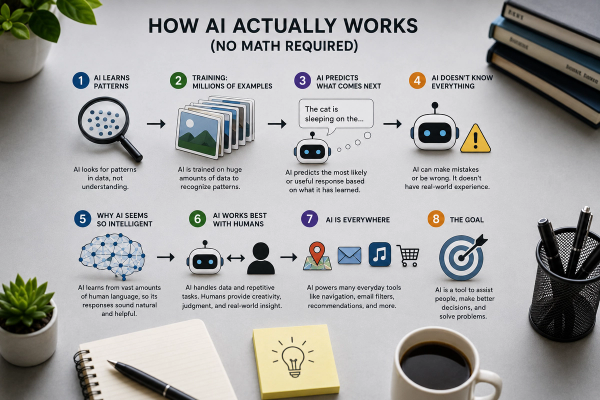
How AI Actually Works (No Math Required)

How to Spot AI-Generated Content Even When It’s Good

The Real Difference Between AI, Machine Learning, and Deep Learning

How to Prompt AI Like a Pro




Read More
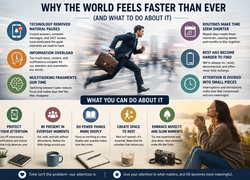
Why the World Feels Faster Than Ever (And What to Do About It)
Astrid Jensen|
Why Some People Notice More Than Others
Joel Anderson|
Why the Slow Things Are Quietly Winning
Brett Crane|
How to Spend Less Without Feeling Deprived
Joel Anderson|
How to Spend a Sunday Like You Mean It
Brett Crane|
The Inventions That Changed How We Live (And Why)
Karina Leon|