

The Two-Minute Rule That Solves Procrastination
A
By Astrid Jensen on July 2, 2026
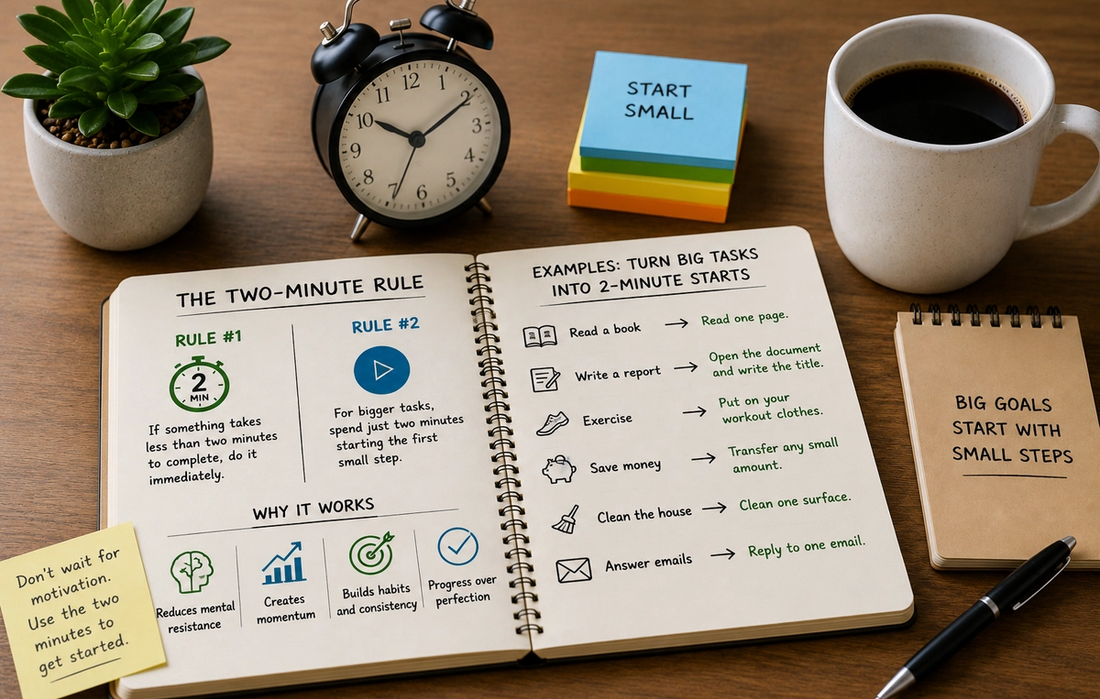
Procrastination has a way of making even the simplest tasks feel overwhelming. You know you should reply to an email, start writing a report, organize your desk, or go for a walk, yet somehow you keep finding reasons to wait until later. The longer you delay, the bigger the task begins to feel, creating a cycle that’s surprisingly difficult to break.
Fortunately, overcoming procrastination doesn’t always require a complicated productivity system or extraordinary willpower. One of the most effective techniques is also one of the simplest: the Two-Minute Rule.
Popularized by productivity expert David Allen and later expanded by author James Clear, the Two-Minute Rule is based on a powerful idea. Instead of focusing on finishing a task, focus only on making it easy enough to begin. It may sound almost too simple to work, but psychology suggests that getting started is often the biggest hurdle standing between intention and action.
Why getting started feels so difficult
Most people don’t procrastinate because they’re lazy. They procrastinate because starting a task often feels emotionally uncomfortable.
Large projects can trigger feelings of uncertainty, boredom, perfectionism, or even fear of failure. Your brain naturally prefers activities that offer immediate rewards, such as checking social media or watching another video, instead of beginning something that requires effort.
The challenge is that our brains tend to exaggerate how difficult a task will be before we’ve actually started it. Writing an article sounds exhausting when you’re looking at a blank page. Cleaning the kitchen feels like an enormous job when you’re thinking about every cupboard and countertop.
Once you begin, however, those tasks often become much easier than you expected.
What is the Two-Minute Rule?
The Two-Minute Rule can be applied in two different ways.
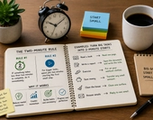
The first version is straightforward: if something takes less than two minutes to complete, do it immediately. Replying to a short email, hanging up your coat, washing a coffee mug, paying a bill, or scheduling an appointment all fall into this category. These tasks usually take less time to complete than they do to remember and postpone.
The second version is especially helpful for larger goals. Instead of trying to complete the entire task, reduce it to something you can begin in two minutes or less.
If you want to read a book, start by reading one page. If you need to write a report, simply open the document and write the title. If you’re planning to exercise, begin by putting on your trainers.
The goal isn’t to finish the task in two minutes. The goal is to make starting so easy that your brain has very little reason to resist.
Small actions create momentum
One of the reasons the Two-Minute Rule is so effective is that action often leads to motivation—not the other way around.
Many people wait until they “feel motivated” before they begin working. Unfortunately, motivation is unpredictable. If you rely on it, you may spend more time waiting than doing.
Starting with a tiny action changes your mental state. Once you’ve opened the laptop, written the first sentence, or stepped outside for a walk, you’ve already overcome the biggest obstacle. At that point, continuing usually feels far easier than stopping.
This phenomenon is sometimes called momentum. Small actions make larger actions feel more natural, allowing progress to build almost effortlessly.
The rule helps build lasting habits
The Two-Minute Rule isn’t only useful for finishing today’s tasks. It’s also one of the simplest ways to build habits that last.
Every long-term habit begins with a small action. People who exercise regularly didn’t start by running marathons. People who read dozens of books each year began by reading a few pages at a time. Even experienced writers start each article by typing a single sentence.
By making the beginning of a habit incredibly easy, you increase the likelihood that you’ll repeat it tomorrow, and the day after that.
Consistency matters far more than intensity. Showing up every day, even briefly, builds routines that become easier over time.
Don’t let small tasks become a distraction
Like any productivity strategy, the Two-Minute Rule works best when it’s used intentionally.
It’s easy to spend an entire morning completing quick, easy tasks while avoiding the one project that actually matters most. Answering emails, organizing folders, or cleaning your desk can certainly be productive, but they shouldn’t become a way of avoiding more meaningful work.
Think of the Two-Minute Rule as a doorway rather than the destination. Its purpose is to help you begin larger tasks—not replace them with an endless list of smaller ones.
Once you’ve started, give yourself permission to keep going if you’re making good progress.
Progress is more important than perfection
One of the biggest reasons people procrastinate is because they expect themselves to produce perfect work from the very beginning.
The Two-Minute Rule gently challenges that mindset. It reminds you that your first responsibility isn’t to finish something perfectly—it’s simply to begin.
A rough draft can always be improved. A short walk can become a longer workout. One cleaned shelf can lead to an organized room.
Perfection rarely creates momentum, but progress almost always does.
A simple habit that can change the way you work
The beauty of the Two-Minute Rule lies in its simplicity. It doesn’t require expensive tools, complicated planning systems, or endless motivation. Instead, it works by reducing the mental resistance that keeps us stuck.
When you stop thinking about completing an entire project and focus only on the first tiny action, the task immediately becomes less intimidating. More often than not, those first two minutes naturally turn into ten, twenty, or even sixty productive minutes.
The next time you catch yourself saying, “I’ll do it later,” try asking a different question: What’s the smallest step I can take in the next two minutes?
You may be surprised by how often that one small decision is enough to get you moving. After all, lasting progress rarely begins with a giant leap—it usually starts with one simple action that takes less than two minutes.

AI

How AI Actually Works (No Math Required)

How to Spot AI-Generated Content Even When It’s Good

The Real Difference Between AI, Machine Learning, and Deep Learning

How to Prompt AI Like a Pro





Read More

Why the World Feels Faster Than Ever (And What to Do About It)
Astrid Jensen|
Why Some People Notice More Than Others
Joel Anderson|

Why the Slow Things Are Quietly Winning
Brett Crane|

How to Spend Less Without Feeling Deprived
Joel Anderson|

How to Spend a Sunday Like You Mean It
Brett Crane|

The Inventions That Changed How We Live (And Why)
Karina Leon|