

How to Prompt AI Like a Pro
J
By Joel Anderson on July 2, 2026
Artificial intelligence has become an incredibly useful tool for writing, brainstorming, researching, coding, planning trips, learning new skills, and solving everyday problems. Yet many people walk away disappointed after using it, believing the technology isn’t as capable as everyone claims.
More often than not, the problem isn’t the AI—it’s the prompt.
A prompt is simply the instruction you give an AI system. Just as a skilled colleague can only help if they understand what you’re asking, AI produces better results when your instructions are clear, specific, and detailed. Small changes in the way you ask a question can dramatically improve the quality of the answer you receive.
The good news is that prompting isn’t a mysterious skill reserved for experts. With a few simple techniques, almost anyone can learn how to get better results from AI.
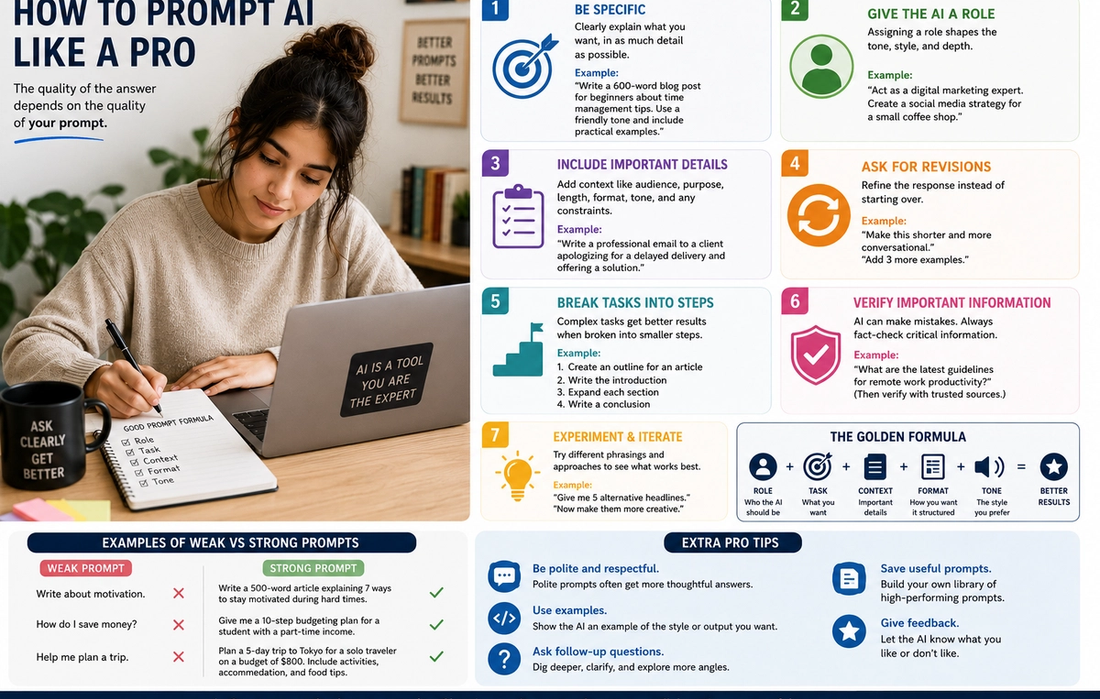
Be specific about what you want
One of the biggest mistakes people make is asking questions that are too broad.
For example, a prompt like “Write me an article about productivity” gives the AI very little direction. It doesn’t know who the audience is, how long the article should be, what tone you want, or which aspects of productivity matter most.
A much stronger prompt would be: “Write an 800-word article for a general audience explaining five science-backed productivity habits. Use a conversational tone, include practical examples, and organize the article with clear section headings.”
The more context you provide, the easier it becomes for the AI to understand exactly what you’re trying to achieve.
Give the AI a role
One of the simplest ways to improve your prompts is to tell the AI who it should be.
For example, you might ask it to act as a travel planner, marketing consultant, career coach, financial educator, teacher, or editor. Giving the AI a role helps shape both the tone and the depth of the response.
Imagine you’re preparing for a job interview. Instead of simply asking, “What questions might I be asked?”, you could say, “Act as an experienced hiring manager interviewing a project manager. Ask realistic interview questions one at a time and provide feedback on my answers.”
That extra context creates a much more useful interaction.
Include important details
AI can’t read your mind.
If there are specific requirements, mention them from the beginning. Explain who the content is for, how formal it should sound, how long it should be, and whether there are any topics or styles you want to avoid.
For example, if you’re writing an email, mention whether it’s going to a colleague, a customer, or a friend. If you’re creating social media content, specify the platform and the audience. If you’re asking for travel advice, mention your budget, destination, and interests.
Think of your prompt as a creative brief. The clearer the brief, the better the final result.
Ask for revisions instead of starting over
One of AI’s biggest strengths is that it can revise its own work almost instantly.
Many people make the mistake of starting from scratch whenever the first answer isn’t exactly what they wanted. A better approach is to build on the existing response by providing additional instructions.
You might ask the AI to make the writing shorter, more professional, more conversational, easier to understand, or better organized. You can request stronger examples, clearer explanations, or a different structure without losing the useful parts of the original draft.
Treat the conversation like working with a human editor rather than expecting perfection on the first attempt.
Break complex tasks into smaller steps
AI often performs better when large projects are divided into manageable stages.
Instead of asking it to create an entire business plan in one prompt, begin by asking for a business idea, then request a market analysis, followed by a marketing strategy and financial projections.
The same principle applies to writing. Start with an outline, review it, refine it, and only then ask for the complete article.
Working step by step gives you more control over the final result and usually produces higher-quality work than trying to accomplish everything in one request.
Verify important information
Although AI is an excellent research assistant, it isn’t perfect.
It can occasionally misunderstand a question, rely on outdated information, or generate inaccurate facts with confidence. That’s why it’s important to verify critical information, especially when it relates to health, finance, legal issues, or technical subjects.
Think of AI as a helpful collaborator rather than an unquestionable authority. It can save enormous amounts of time, but important decisions should always be supported by reliable sources and your own judgment.
The best results come from combining AI’s speed with human critical thinking.
Experiment with different approaches
There isn’t one perfect way to write a prompt.
Sometimes a small adjustment completely changes the quality of the response. If one prompt doesn’t produce the result you’re looking for, try rephrasing it, adding more context, or asking the AI to explain its reasoning.
Over time, you’ll begin to notice which types of instructions consistently produce better outcomes.
Like any skill, prompting improves with practice. The more you experiment, the more naturally you’ll learn how to communicate with AI effectively.
Great prompts lead to great results
Artificial intelligence is an incredibly powerful tool, but its usefulness depends largely on the quality of the instructions it receives.
Clear prompts, specific context, realistic expectations, and thoughtful follow-up questions can transform an average response into something genuinely valuable. Rather than expecting AI to guess what you want, treat it like a skilled collaborator that performs best when given a clear objective.
As AI becomes part of more workplaces, classrooms, and everyday tasks, knowing how to write effective prompts will become an increasingly valuable skill. It’s not about learning secret commands or complicated formulas. It’s simply about asking better questions, providing better context, and working with the technology instead of expecting it to do all the thinking for you.
In the end, the people who get the most value from AI won’t necessarily be those using the most advanced tools. They’ll be the ones who know how to communicate their ideas clearly, refine the results thoughtfully, and combine artificial intelligence with their own creativity and judgment.


AI
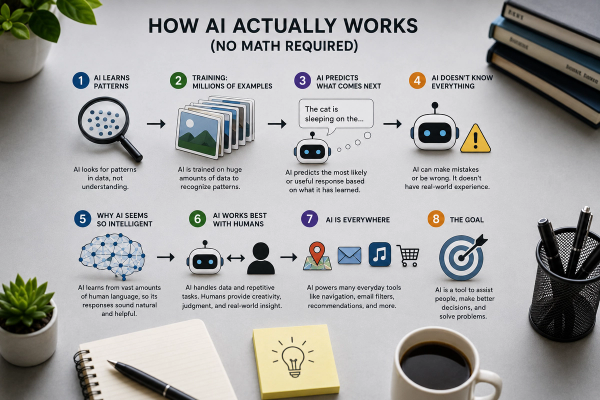
How AI Actually Works (No Math Required)

How to Spot AI-Generated Content Even When It’s Good

The Real Difference Between AI, Machine Learning, and Deep Learning

How to Prompt AI Like a Pro







Read More

Why the World Feels Faster Than Ever (And What to Do About It)
Astrid Jensen|
Why Some People Notice More Than Others
Joel Anderson|

Why the Slow Things Are Quietly Winning
Brett Crane|

How to Spend Less Without Feeling Deprived
Joel Anderson|

How to Spend a Sunday Like You Mean It
Brett Crane|

The Inventions That Changed How We Live (And Why)
Karina Leon|