

How Small Innovations Compound Into Big Changes
C
By Celine Flynn on July 2, 2026
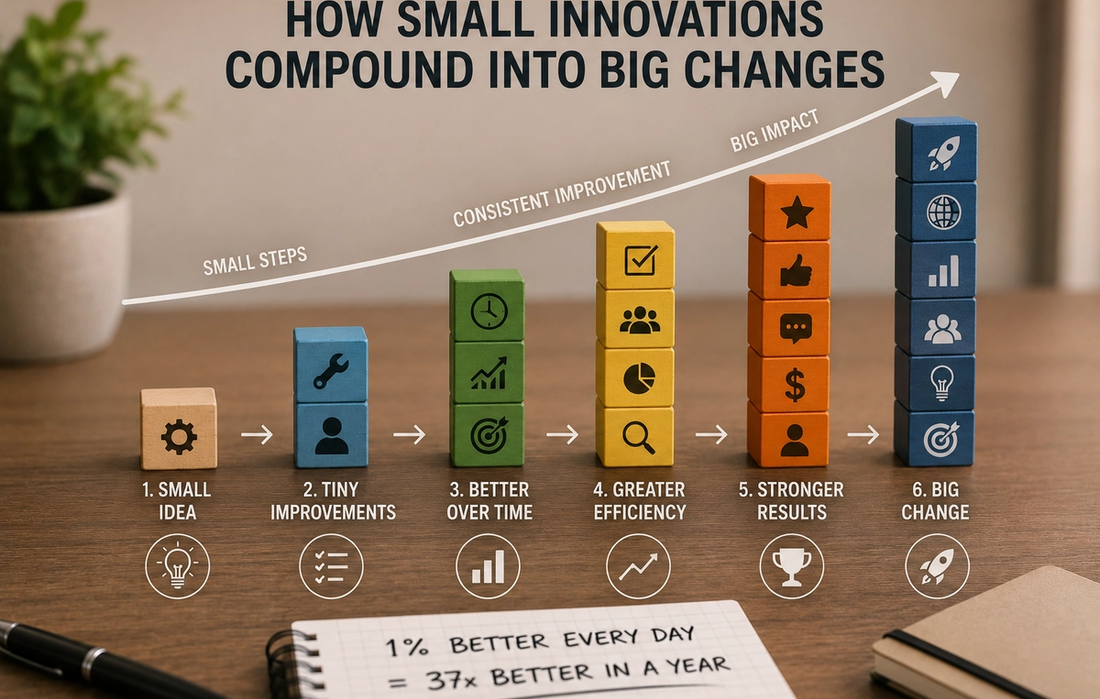
When people think about innovation, they often picture groundbreaking inventions that transform the world overnight. The internet, the smartphone, or artificial intelligence are usually seen as dramatic leaps forward that instantly changed how people live and work. While these breakthroughs have undoubtedly shaped history, they tell only part of the story.
In reality, most progress happens gradually. Behind every revolutionary product are hundreds—sometimes thousands—of small improvements that made it faster, cheaper, safer, or easier to use. These individual changes may seem insignificant on their own, but over time they build upon one another, creating results that are far greater than anyone could have predicted.
This process is known as compounding, and it’s one of the most powerful forces behind innovation. Just as small financial investments can grow through compound interest, small improvements can accumulate into transformative change.
Great products are rarely perfect from the beginning
Many people imagine that successful products arrive fully developed, but history tells a different story.
The first automobiles were slow, unreliable, and difficult to operate. Early computers filled entire rooms while performing calculations that modern smartphones complete in fractions of a second. The earliest mobile phones were expensive, heavy, and offered only basic calling features.
None of these products became successful because they were perfect from day one. They improved gradually through thousands of small innovations. Engineers refined designs, manufacturers reduced costs, software developers added new capabilities, and customer feedback guided future improvements.
Over time, those incremental changes transformed experimental technologies into products that billions of people now use every day.
Small improvements reduce friction
One reason small innovations matter so much is that they remove friction from everyday life.
Think about how many products have become easier to use over the years. Websites load faster, batteries last longer, online payments require fewer steps, navigation apps automatically suggest better routes, and software updates fix problems users once accepted as normal.
Each improvement may save only a few seconds or eliminate one small inconvenience, but across millions of people and countless daily interactions, the impact becomes enormous.
Innovation isn’t always about adding something new. Often, it’s about removing unnecessary complexity.
Continuous improvement beats occasional breakthroughs
Businesses sometimes believe they need one revolutionary idea to stay competitive. In reality, companies that consistently improve their products often outperform those waiting for a single dramatic breakthrough.
A restaurant that slightly improves its customer service every month, a software company that regularly fixes bugs and introduces useful features, or a manufacturer that gradually reduces production waste all become stronger over time.
These improvements rarely attract headlines, but they create lasting advantages because competitors find it difficult to match years of steady progress all at once.
Consistency, rather than occasional brilliance, often produces the greatest long-term results.
Customer feedback drives innovation
Many important improvements don’t begin in research laboratories—they begin with customer conversations.
People naturally discover ways products can be clearer, faster, more comfortable, or more reliable. Businesses that listen carefully to this feedback gain valuable insights into what truly matters.
A redesigned handle may make a tool easier to use. Simpler software menus can reduce confusion. Faster customer support can improve trust. Better packaging can prevent products from being damaged during delivery.
Individually, these changes may appear minor. Collectively, they transform the overall experience and strengthen customer loyalty.
The most successful companies rarely assume they’ve finished improving.
Technology evolves through accumulation
Modern technology demonstrates the power of compounding particularly well.
Today’s smartphones weren’t created through one extraordinary invention. They evolved through countless smaller advances in battery technology, processors, cameras, touchscreens, wireless communication, software, sensors, and manufacturing techniques.
Artificial intelligence has followed a similar path. Decades of improvements in computing power, data availability, algorithms, and hardware gradually enabled the AI systems we use today.
Each breakthrough depended on countless earlier improvements that made the next step possible.
Progress rarely moves in isolated jumps. More often, it builds layer upon layer until the final result appears revolutionary.
Small habits create innovation too
Compounding isn’t limited to technology or business. It also applies to people.
Reading a few pages every day may not seem significant, but over the course of a year it can become dozens of books. Learning one new skill every few months gradually creates expertise that opens new career opportunities. Saving a small amount of money consistently often produces remarkable long-term financial results.
Innovation frequently begins with habits rather than dramatic moments of inspiration.
People who continually improve their knowledge, skills, and routines often achieve extraordinary results through ordinary actions repeated consistently.
Patience is part of the process
One reason many people underestimate small improvements is that their benefits aren’t immediately visible.
The first software update may feel insignificant. The first manufacturing improvement may barely affect production costs. Reading for ten minutes today won’t instantly make someone an expert.
Compounding requires patience.
The value appears gradually as improvements accumulate over months or years. Eventually, people looking back often describe the change as sudden, even though it was built through hundreds of incremental steps.
Recognizing this process encourages persistence during periods when progress seems slow.
Big changes often begin with small ones
History tends to celebrate dramatic breakthroughs because they’re easy to remember. Yet behind almost every major innovation lies a long series of small improvements that received far less attention.
Whether it’s better product design, more efficient manufacturing, improved software, or tiny adjustments suggested by customers, these changes combine to create technologies and experiences that eventually reshape industries.
This principle extends beyond business. It applies equally to learning, health, finances, and personal growth. The small actions people repeat consistently often produce the greatest long-term transformation.
Innovation isn’t always about inventing something entirely new. More often, it’s about making something just a little better than it was yesterday.
Over time, those modest improvements compound into results that can change companies, industries, and even the way we live. That’s why some of the biggest changes in history didn’t begin with one extraordinary leap—they began with one small improvement, followed by another, and another, until progress became impossible to ignore.


AI

How AI Actually Works (No Math Required)

How to Spot AI-Generated Content Even When It’s Good

The Real Difference Between AI, Machine Learning, and Deep Learning

How to Prompt AI Like a Pro








Read More

Why the World Feels Faster Than Ever (And What to Do About It)
Astrid Jensen|
Why Some People Notice More Than Others
Joel Anderson|

Why the Slow Things Are Quietly Winning
Brett Crane|

How to Spend Less Without Feeling Deprived
Joel Anderson|

How to Spend a Sunday Like You Mean It
Brett Crane|

The Inventions That Changed How We Live (And Why)
Karina Leon|