

How to Use AI Without Losing Your Skills
B
By Brett Crane on July 2, 2026
Artificial intelligence has quickly become one of the most useful tools available today. It can summarize long documents, write emails, brainstorm ideas, generate code, translate languages, analyze data, and answer questions in seconds. Tasks that once took hours can now be completed in minutes, making AI an incredibly valuable assistant for students, professionals, and businesses alike.
As powerful as these tools are, they also raise an important question: if AI starts doing more of our work, what happens to our own skills?
It’s a reasonable concern. History shows that whenever technology automates part of a task, people can become less practiced at doing it themselves. Navigation apps have reduced the need to memorize directions, calculators have changed the way many people perform arithmetic, and search engines have made it unnecessary to remember countless facts. AI has the potential to do something similar with writing, problem-solving, research, and creative work.
The key isn’t to avoid AI altogether. It’s learning how to use it in ways that make you more capable rather than more dependent.
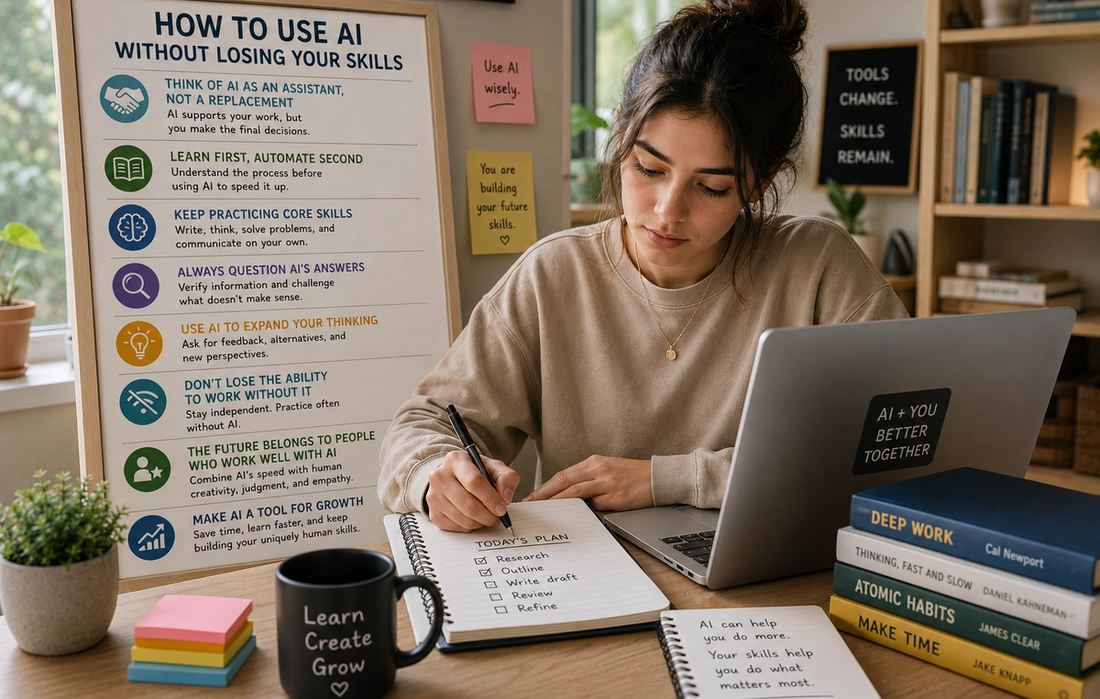
Think of AI as an assistant, not a replacement
The healthiest way to approach AI is to treat it as a collaborator rather than someone who does all the work for you.
Imagine working with an experienced colleague. You might ask them to review your ideas, suggest improvements, or help solve a difficult problem, but you wouldn’t expect them to make every decision on your behalf. AI works best in much the same way.
It can generate a first draft, organize information, or explain a complicated concept, but the final judgment should still come from you. Your experience, critical thinking, and understanding of context remain essential parts of the process.
Using AI to support your work is very different from allowing it to replace your thinking.
Learn first, automate second
One of the biggest mistakes people make is using AI to skip the learning process.
If you’re learning a new language, writing your first computer program, or studying mathematics, immediately asking AI for every answer may help you finish faster, but it won’t necessarily help you improve.
A better approach is to attempt the task yourself first. Solve the problem, write the paragraph, or develop your own ideas before comparing your work with AI’s suggestions. This allows you to identify gaps in your understanding while still benefiting from the technology.
The goal isn’t simply to complete the task—it’s to develop the ability to complete similar tasks independently in the future.
Keep practicing core skills
Some abilities remain valuable regardless of how advanced AI becomes.
Critical thinking, communication, creativity, decision-making, and problem-solving all require human judgment that AI cannot fully replace. These skills improve through regular practice, not by outsourcing them.
If you regularly write reports, continue writing. If you’re learning to code, keep solving problems yourself. If you’re developing presentation skills, practice organizing your own ideas before asking AI to refine them.
The more you continue exercising these abilities, the less likely they are to weaken over time.
Technology should help you become better at your work—not gradually take your place in it.
Always question AI’s answers
AI often produces confident, well-written responses, but confidence doesn’t always equal accuracy.
Like any tool, AI can misunderstand questions, overlook important context, or provide incorrect information. That’s why one of the most valuable habits you can develop is verifying what it tells you.
Instead of accepting every answer immediately, ask yourself:
- Does this make sense?
- Can I confirm this using reliable sources?
- Is anything missing?
- Would I confidently explain this to someone else?
These questions keep your critical thinking active and prevent you from relying on AI as an unquestionable authority.
Use AI to expand your thinking
Many people see AI as a shortcut. A more valuable approach is to use it as a way to think more broadly.
Instead of asking AI to simply complete a task, ask it to challenge your assumptions, suggest alternative ideas, explain opposing viewpoints, or identify weaknesses in your argument.
For example, if you’re writing an article, you might ask AI to point out sections that need clarification. If you’re planning a business, ask it to identify potential risks. If you’re preparing for an interview, have it ask difficult questions you might not have considered.
In these situations, AI isn’t replacing your thinking—it is strengthening it.
Don’t lose the ability to work without it
Imagine your internet connection disappears for a day.
Could you still write an email, solve a problem, organize your thoughts, or make an important decision?
Maintaining that independence matters.
Just as calculators didn’t eliminate the importance of understanding basic mathematics, AI shouldn’t eliminate your ability to think, communicate, or solve problems on your own.
Occasionally completing tasks without AI is an excellent way to keep your skills sharp. It reminds you what you already know and highlights areas where further learning might be useful.
The future belongs to people who work well with AI
Artificial intelligence is unlikely to replace everyone. More likely, it will change how many people work.
Those who understand how to combine AI’s speed with human creativity, judgment, empathy, and expertise will have a significant advantage. They’ll complete routine work more efficiently while focusing their energy on the tasks that require uniquely human abilities.
Rather than competing against AI, they’ll learn how to collaborate with it effectively.
This is similar to how previous generations learned to work alongside computers, spreadsheets, and the internet. The people who adapted didn’t lose their value—they expanded it.
Make AI a tool for growth
Artificial intelligence is one of the most powerful productivity tools ever created, but like any tool, its impact depends on how it’s used.
If you rely on AI to think for you, your own skills may gradually weaken. If you use it to challenge your ideas, accelerate routine work, and support your learning, it can help you become more capable than before.
The goal isn’t to prove you can do everything without AI. Nor is it to let AI do everything for you.
The smartest approach lies somewhere in the middle. Use AI to save time on repetitive tasks, gain new perspectives, and learn faster—but continue practicing the skills that make you uniquely human.
In the years ahead, those skills won’t become less important. They’ll become the qualities that matter most.


AI
How AI Actually Works (No Math Required)

How to Spot AI-Generated Content Even When It’s Good
The Real Difference Between AI, Machine Learning, and Deep Learning
How to Prompt AI Like a Pro






Read More

Why the World Feels Faster Than Ever (And What to Do About It)
Astrid Jensen|
Why Some People Notice More Than Others
Joel Anderson|

Why the Slow Things Are Quietly Winning
Brett Crane|

How to Spend Less Without Feeling Deprived
Joel Anderson|

How to Spend a Sunday Like You Mean It
Brett Crane|
The Inventions That Changed How We Live (And Why)
Karina Leon|