

The Companies Quietly Reshaping Their Industries
J
By Joel Anderson on July 2, 2026
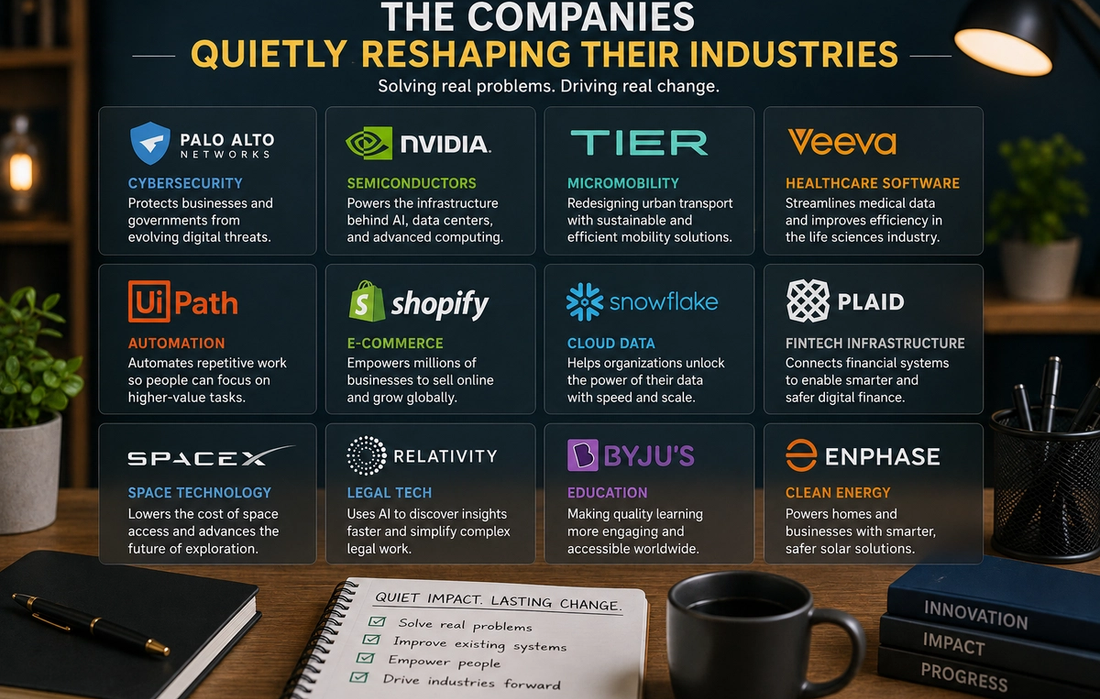
When people think about companies changing the world, the same names usually come to mind. Global technology giants dominate headlines with billion-dollar product launches, artificial intelligence breakthroughs, and ambitious long-term visions. Yet many of the businesses having the greatest impact on their industries receive far less public attention.
These companies aren’t necessarily the biggest or the most recognizable. Instead, they’re quietly transforming the way entire industries operate by solving practical problems, improving efficiency, or introducing better ways of working. Some build software that most consumers never see, while others develop technologies that power hospitals, factories, logistics networks, or financial services behind the scenes.
Their success offers an important reminder that innovation isn’t always loud. Often, the companies creating lasting change focus less on attracting attention and more on consistently solving real-world problems.
They solve problems most people never notice
Many of today’s fastest-growing businesses don’t sell products directly to consumers. Instead, they build tools that help other organizations operate more effectively.
A company might create software that helps hospitals manage patient records more efficiently, develop systems that optimize delivery routes for logistics firms, or build cybersecurity platforms that protect businesses from increasingly sophisticated online threats. Most people will never interact with these products directly, yet millions benefit from them every day.
Because these companies operate behind the scenes, they rarely become household names. Nevertheless, their technologies often support services that people rely on daily without realizing it.
They improve existing industries instead of creating new ones
Innovation isn’t always about inventing something completely new. In many cases, the greatest opportunities come from improving industries that have changed very little over time.
Construction companies are using digital tools to manage complex projects more efficiently. Agricultural technology firms are helping farmers monitor crops with greater precision. Healthcare companies are simplifying administrative work so medical professionals can spend more time with patients. Financial technology businesses are making payments faster and more accessible for individuals and small businesses alike.
These improvements may not generate dramatic headlines, but they steadily reshape industries by making them more productive, affordable, and responsive to customers’ needs.
Software has become the engine of transformation
One of the biggest trends across nearly every sector is the growing role of software.
Manufacturing companies now rely on data analytics to predict equipment failures before they happen. Retailers use artificial intelligence to forecast demand and manage inventory more accurately. Professional service firms automate routine administrative work, allowing employees to focus on higher-value tasks.
Increasingly, competitive advantage comes not only from producing better products but also from building better systems.
Companies that successfully combine software, automation, and human expertise often find themselves outperforming competitors that continue relying on outdated processes.
Artificial intelligence is accelerating change
Artificial intelligence is becoming one of the most important tools driving innovation across industries.
Rather than replacing employees outright, many organizations are using AI to automate repetitive work, analyze large amounts of information, improve customer support, and assist with decision-making. Marketing teams generate first drafts more quickly, legal professionals summarize lengthy documents, healthcare providers identify patterns in medical data, and manufacturers improve quality control through computer vision.
The companies benefiting most from AI aren’t necessarily those building the technology themselves. They’re the ones finding practical ways to integrate it into everyday workflows, allowing people to work faster, make better decisions, and focus on more meaningful tasks.
Customer experience has become a competitive advantage
Many successful companies distinguish themselves not through revolutionary technology but through exceptional customer experiences.
Businesses that simplify complicated processes, provide transparent pricing, respond quickly to customer questions, or design products that are intuitive to use often earn lasting loyalty. In highly competitive industries, convenience and trust can become just as valuable as technical innovation.
This shift has encouraged companies to invest heavily in user experience, customer support, and product design. Instead of asking only, “Can we build this?” they increasingly ask, “How can we make this easier for our customers?”
That mindset often separates businesses that grow steadily from those that struggle to keep pace.
Quiet innovation often creates lasting impact
Many breakthrough companies spend years refining their products before attracting widespread attention.
They improve one feature at a time, listen carefully to customer feedback, and focus on sustainable growth rather than chasing headlines. By the time the wider public notices them, they’ve often already transformed their industry.
This gradual approach is common among successful businesses. They understand that lasting change usually comes from consistently delivering value rather than constantly generating publicity.
Their influence is measured not by media coverage but by the number of organizations that quietly depend on their products every day.
Tomorrow’s industry leaders may already exist
History shows that today’s unknown companies can become tomorrow’s market leaders.
Many of the world’s most influential businesses began by solving a narrow problem for a small group of customers. As they improved their products and expanded into new markets, their impact grew far beyond what anyone initially expected.
The same pattern continues today. Across sectors such as artificial intelligence, renewable energy, healthcare, cybersecurity, biotechnology, and advanced manufacturing, thousands of businesses are developing solutions that may shape the next decade.
Most won’t become famous, but many will play an important role in transforming how industries operate.
The biggest changes often happen behind the scenes
When people talk about innovation, attention naturally gravitates toward high-profile product launches and headline-making announcements. Yet much of the real transformation happens quietly.
Companies that improve supply chains, strengthen cybersecurity, modernize healthcare systems, automate routine work, or simplify complex business processes rarely dominate the news, but their contributions affect millions of people every day.
Ultimately, the businesses that reshape industries aren’t always the loudest or the most recognizable. More often, they’re the ones that consistently solve meaningful problems, embrace continuous improvement, and help others work more effectively.
In the long run, those quiet improvements often have a greater impact than the biggest headlines. They’re the foundation upon which entire industries evolve, proving that lasting innovation is usually measured not by how much attention it receives, but by how much better it makes everyday life.


AI
How AI Actually Works (No Math Required)

How to Spot AI-Generated Content Even When It’s Good

The Real Difference Between AI, Machine Learning, and Deep Learning

How to Prompt AI Like a Pro








Read More

Why the World Feels Faster Than Ever (And What to Do About It)
Astrid Jensen|
Why Some People Notice More Than Others
Joel Anderson|

Why the Slow Things Are Quietly Winning
Brett Crane|

How to Spend Less Without Feeling Deprived
Joel Anderson|

How to Spend a Sunday Like You Mean It
Brett Crane|
The Inventions That Changed How We Live (And Why)
Karina Leon|