
The Cultural Power of Paying Attention
J
By Jessica Stuart on July 2, 2026
Attention has quietly become one of the most valuable resources of the modern age.
Every day, countless apps, websites, advertisements, news outlets, and social media platforms compete for a few moments of our focus. Notifications arrive constantly, videos autoplay before the previous one has finished, and algorithms are designed to keep us scrolling for as long as possible. In a world where information has become abundant, attention has become scarce.
Because this shift happened gradually, many of us barely noticed it. Yet the way we pay attention shapes much more than our productivity. It influences our relationships, our opinions, our creativity, our culture, and even the way we understand ourselves.
Paying attention isn’t simply about concentrating better. It’s about deciding what deserves a place in our lives.
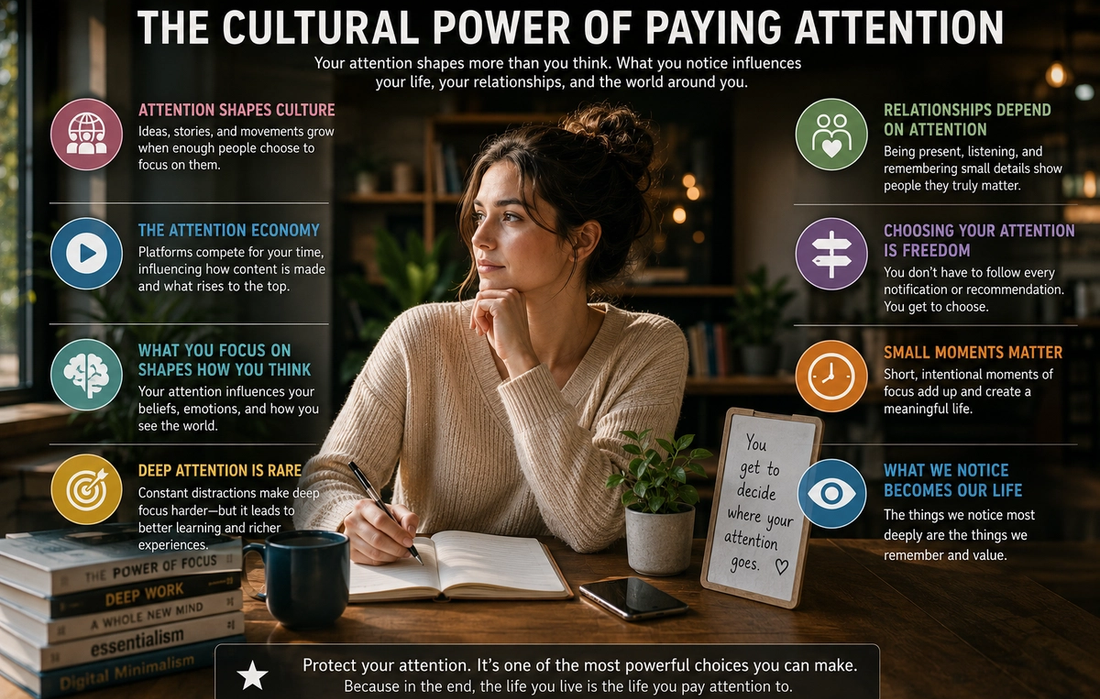
Attention shapes culture
Culture isn’t only created by artists, filmmakers, writers, or musicians. It’s also shaped by what millions of people collectively choose to notice.
When an idea receives widespread attention, it spreads quickly. Books become bestsellers, songs dominate playlists, social movements gain momentum, and businesses grow because enough people decide they are worth paying attention to.
At the same time, equally important ideas can remain almost invisible simply because they struggle to compete for attention in an increasingly crowded digital world.
In many ways, attention acts like a vote. Every article we read, video we watch, creator we support, or conversation we engage in helps determine what becomes culturally significant.
The attention economy changes how content is created
Today’s internet operates within what many people call the attention economy.
Instead of competing only on quality, many platforms compete for time. The longer they can hold your attention, the more opportunities they have to display advertisements, recommend additional content, or encourage further engagement.
This has influenced how content is produced.
Headlines have become more dramatic. Videos often begin with attention-grabbing moments. News cycles move faster than ever, and creators are encouraged to publish constantly in order to remain visible.
Much of this content is informative and entertaining, but it also encourages habits of continuous consumption rather than careful reflection.
Understanding these incentives helps us become more intentional about how we spend our attention.
What you pay attention to shapes how you think
Attention is closely connected to memory.
The ideas, conversations, and experiences that receive your focus are more likely to influence your beliefs, emotions, and long-term understanding of the world.
If most of your attention is spent consuming outrage, conflict, or endless comparison on social media, it’s likely to affect how you perceive reality. On the other hand, regularly reading thoughtful books, engaging in meaningful conversations, or learning new skills gradually shapes your thinking in very different ways.
This doesn’t mean avoiding entertainment or difficult topics.
It simply means recognizing that attention is never neutral. What repeatedly occupies your mind slowly becomes part of how you see the world.
Deep attention has become increasingly rare
One of the biggest consequences of constant digital stimulation is that uninterrupted focus has become harder to maintain.
Many people now read articles while checking messages, watch television while scrolling through social media, or answer emails during meetings. Although this constant switching feels normal, it often reduces both concentration and enjoyment.
Deep attention—the ability to focus fully on one task, conversation, or idea—is becoming increasingly valuable precisely because it’s becoming less common.
Whether you’re reading a novel, learning a new skill, solving a complex problem, or simply listening carefully to another person, sustained attention allows for richer experiences than constant multitasking ever can.
Relationships depend on attention
One of the greatest ways we show someone they matter is by giving them our full attention.
Listening without checking a phone, maintaining eye contact during conversations, remembering small details about another person’s life, or being fully present during family meals all communicate something powerful: You matter enough for me to be here with you.
These moments often strengthen relationships more than expensive gifts or elaborate plans.
In a world filled with distractions, genuine attention has become one of the rarest and most meaningful expressions of care.
Choosing your attention is a form of freedom
Technology constantly offers suggestions about what to watch next, what to read, what to buy, and even what to think about.
While these recommendations can be helpful, they also make it easy to spend hours following someone else’s priorities instead of your own.
Choosing your attention intentionally is one way of reclaiming control.
That might mean deciding to read a book instead of endlessly scrolling, having a long conversation instead of checking notifications, or spending time creating something rather than only consuming what others have made.
Every intentional choice strengthens your ability to direct your own life instead of allowing algorithms to do it for you.
Small moments of focus create meaningful change
Paying attention doesn’t require dramatic lifestyle changes.
Often, it’s the ordinary moments that matter most.
Reading without interruptions for twenty minutes. Walking without looking at your phone. Listening carefully during a conversation. Finishing one task before beginning another. Watching a sunset without feeling the need to photograph it immediately.
These moments remind us that attention isn’t only about efficiency.
It’s about fully experiencing the life that’s already happening around us.
What we notice becomes the life we remember
Looking back on life, most people don’t remember the hundreds of notifications they answered or the countless posts they scrolled past.
They remember meaningful conversations, shared meals, books that changed how they thought, unforgettable journeys, acts of kindness, and moments when they felt fully present.
Those memories exist because they received our attention.
The things we notice most deeply often become the experiences that shape us.
Attention is one of the most powerful choices we make
In a world where nearly everything competes for our focus, paying attention has become more than a personal habit. It’s a cultural force.
Our attention influences which ideas spread, which businesses succeed, which relationships grow stronger, and how we experience our own lives. Every day, we decide—sometimes consciously, sometimes automatically—what deserves a place in our minds.
Those choices matter.
Because in the end, our lives are shaped not only by what happens to us, but by what we choose to notice. Protecting your attention isn’t about disconnecting from the world. It’s about making sure the world you’re paying attention to is one worth living in.

AI
How AI Actually Works (No Math Required)

How to Spot AI-Generated Content Even When It’s Good

The Real Difference Between AI, Machine Learning, and Deep Learning

How to Prompt AI Like a Pro






Read More

Why the World Feels Faster Than Ever (And What to Do About It)
Astrid Jensen|
Why Some People Notice More Than Others
Joel Anderson|

Why the Slow Things Are Quietly Winning
Brett Crane|
How to Spend Less Without Feeling Deprived
Joel Anderson|

How to Spend a Sunday Like You Mean It
Brett Crane|
The Inventions That Changed How We Live (And Why)
Karina Leon|