

The Difference Between Invention and Innovation
J
By Jessica Stuart on July 2, 2026
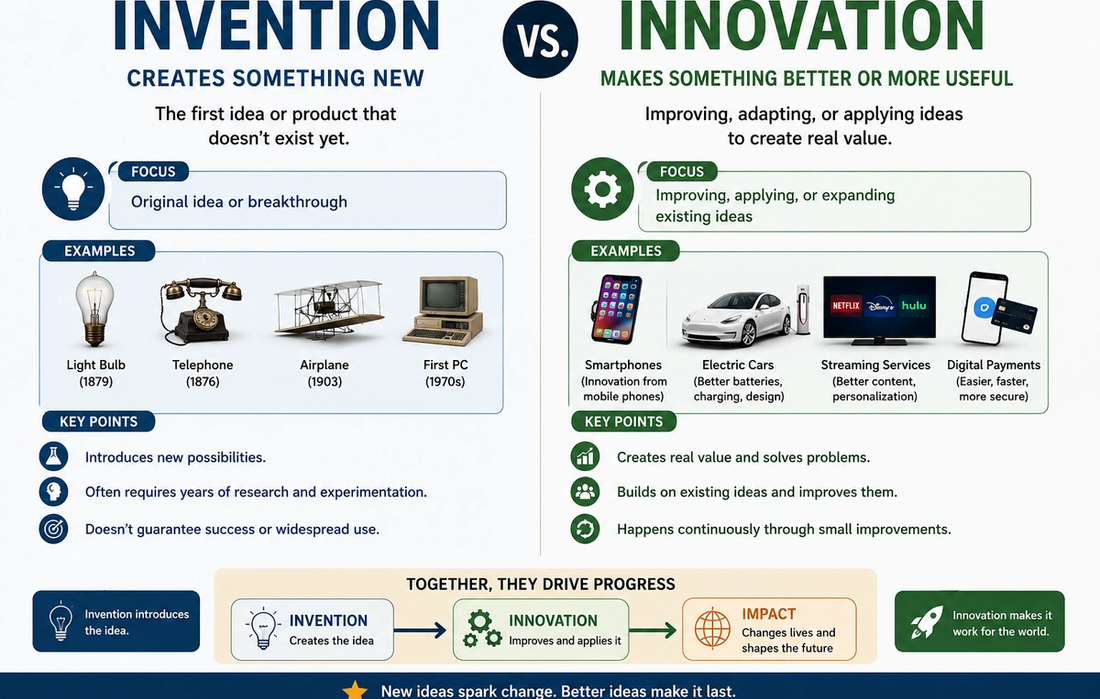
The words invention and innovation are often used as if they mean exactly the same thing. In business articles, technology news, and everyday conversations, people frequently describe a new product or breakthrough as both an invention and an innovation without making any distinction between the two.
Although they’re closely related, they describe different stages of progress.
An invention is the creation of something new. Innovation is the process of improving, applying, or expanding an idea so that it creates real value. In simple terms, inventions introduce possibilities, while innovations turn those possibilities into solutions that change the way people live and work.
Understanding the difference helps explain why some brilliant ideas never become successful products, while others transform entire industries without introducing completely new technology.
An invention creates something new
An invention is the first appearance of a new idea, product, process, or technology.
It represents something that didn’t previously exist, whether that’s a physical object, a scientific breakthrough, or a completely original method of solving a problem. Inventors often spend years experimenting, testing prototypes, and refining their ideas before creating something genuinely new.
History is full of remarkable inventions. The light bulb, the telephone, the airplane, and the first personal computer all introduced technologies that fundamentally changed what was possible.
Without inventions, progress would eventually come to a standstill because there would be no new ideas for future generations to build upon.
However, inventing something doesn’t automatically guarantee that people will use it or that it will become commercially successful.
Innovation makes ideas useful
Innovation begins after the invention.
Rather than focusing on creating something entirely new, innovation improves existing ideas or finds better ways to apply them. Sometimes this means making a product cheaper, easier to use, more reliable, or accessible to a larger audience.
For example, the first mobile phone was an important invention. The smartphones we use today are the result of decades of innovation. Better cameras, faster processors, longer battery life, touchscreens, mobile apps, and improved software all transformed an early invention into an everyday necessity.
Innovation often happens gradually through hundreds of small improvements rather than one dramatic breakthrough.
You don’t always need a new invention to innovate
One of the biggest misconceptions about innovation is that it always requires inventing something completely new.
In reality, many of the world’s most successful companies became leaders by improving existing products instead of creating entirely original technologies.
A business might redesign a familiar product to make it easier to use, develop software that simplifies a complicated task, or find a more efficient way to manufacture something people already buy.
These improvements may seem small individually, but together they can completely change how people experience a product or service.
Innovation is often about solving problems more effectively than anyone else.
Why some inventions never succeed
History contains countless examples of brilliant inventions that never achieved widespread success.
Sometimes the technology arrived before people were ready for it. In other cases, it was too expensive, too complicated, or lacked the supporting infrastructure needed for adoption.
An excellent invention still needs the right timing, practical design, manufacturing capabilities, and customer demand to succeed.
This is where innovation becomes essential.
By refining an invention, reducing costs, improving usability, and adapting it to people’s needs, innovators help bridge the gap between a clever idea and a successful product.
Innovation happens in every industry
When people hear the word innovation, they often think about technology companies.
In reality, innovation happens everywhere.
Hospitals improve patient care through new procedures. Farmers develop more efficient ways to grow crops. Teachers introduce better methods of learning. Restaurants redesign menus and customer experiences. Manufacturers reduce waste while improving quality.
Innovation isn’t limited to inventing cutting-edge technology.
It’s about finding better ways to solve problems, improve experiences, and create value regardless of the industry.
Small improvements can have enormous impact
Not every innovation changes the world overnight.
Some of the most influential improvements are surprisingly small.
A redesigned handle makes a tool easier to hold. A software update reduces the number of clicks needed to complete a task. Better packaging keeps food fresh for longer. A simpler checkout process encourages more online purchases.
Individually, these improvements may seem minor. Collectively, they transform how products perform and how customers experience them.
This process of continuous refinement is one of the reasons successful products continue evolving long after their original invention.
The best companies combine both
Many of the world’s most influential organizations succeed because they value both invention and innovation.
Research teams develop new technologies, while engineers, designers, and product teams work to improve them until they’re practical, reliable, and appealing to customers.
Without invention, there would be no breakthrough ideas.
Without innovation, many inventions would remain prototypes sitting in laboratories rather than becoming products that improve everyday life.
The two concepts work together rather than competing with each other.
Progress depends on both ideas and improvement
Human progress has always relied on a combination of bold new ideas and the determination to improve them over time.
Inventions expand what’s possible. Innovations make those possibilities useful, affordable, and accessible to millions of people.
Whether it’s electricity, the internet, smartphones, renewable energy, or artificial intelligence, every major technological advance has followed this pattern. Someone first imagined a new possibility, and countless others refined it through years of continuous innovation.
Understanding the difference between invention and innovation reminds us that changing the world isn’t always about creating something completely new. Sometimes it’s about taking an existing idea and making it work so well that it transforms the way people live.
Both inventors and innovators play essential roles in shaping the future. One introduces the idea, while the other helps it reach its full potential. Together, they drive the progress that improves our lives generation after generation.


AI
How AI Actually Works (No Math Required)

How to Spot AI-Generated Content Even When It’s Good

The Real Difference Between AI, Machine Learning, and Deep Learning

How to Prompt AI Like a Pro








Read More

Why the World Feels Faster Than Ever (And What to Do About It)
Astrid Jensen|
Why Some People Notice More Than Others
Joel Anderson|

Why the Slow Things Are Quietly Winning
Brett Crane|

How to Spend Less Without Feeling Deprived
Joel Anderson|

How to Spend a Sunday Like You Mean It
Brett Crane|
The Inventions That Changed How We Live (And Why)
Karina Leon|