
The Ideas That Sounded Crazy and Turned Out Right
B
By Brett Crane on July 2, 2026
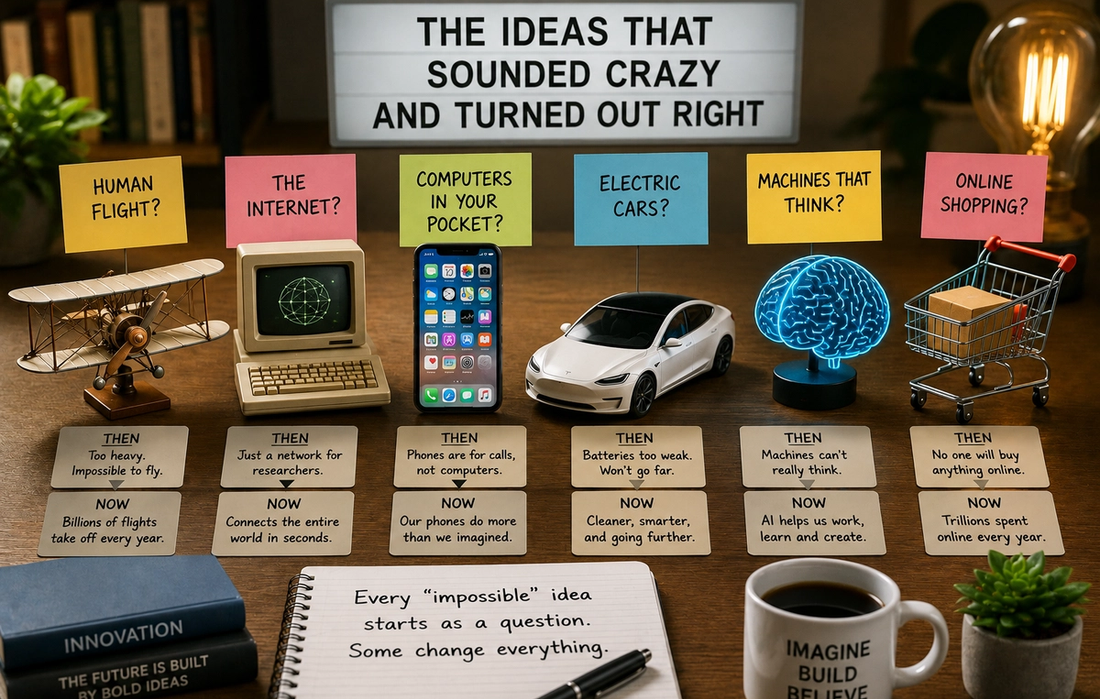
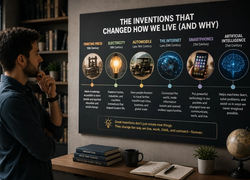
History has a funny way of making bold ideas seem obvious in hindsight. Today, we take airplanes, smartphones, online shopping, and electric cars for granted, but there was a time when each of these innovations was dismissed as unrealistic, impractical, or simply impossible.
Every generation has ideas that challenge the way people think. At first, they’re often met with skepticism because they don’t fit existing assumptions about how the world works. Critics point out the risks, the technical limitations, or the reasons something “will never catch on.” Sometimes they’re right—but sometimes those unlikely ideas go on to reshape entire industries and change everyday life.
Looking back at history reveals an important pattern. Progress often begins with ideas that seem unrealistic, not because they’re impossible, but because they’re unfamiliar.
People naturally resist unfamiliar ideas
Human beings are remarkably adaptable, but we’re also creatures of habit. When a new invention challenges something we’ve always known, our first instinct is often skepticism.
Imagine hearing someone claim a hundred years ago that people would carry powerful computers in their pockets, hold video conversations with people on the other side of the world, or order groceries from a device that fits in one hand. At the time, those predictions would have sounded more like science fiction than realistic forecasts.
This reaction is perfectly normal. We tend to judge new ideas based on the world as it exists today rather than imagining how technology, infrastructure, and society might evolve over time.
That’s why so many groundbreaking innovations initially seem impossible.
Flight was once considered unrealistic
For centuries, human flight was viewed as an impossible dream. Although inventors experimented with flying machines for generations, many experts believed that powered flight simply couldn’t be achieved.
When the first successful airplanes finally appeared in the early twentieth century, few people imagined they would one day connect continents, transport millions of passengers every day, and transform global business, tourism, and culture.
Modern aviation didn’t emerge from one perfect invention. It improved through countless engineering advances that gradually made flying safer, faster, and more affordable.
What once seemed impossible eventually became one of the foundations of the modern world.
The internet changed far more than communication
The internet began as a way to connect computers and share information between researchers. Few people predicted that it would eventually reshape almost every aspect of daily life.
Today we work remotely, stream entertainment, shop online, learn new skills, manage our finances, communicate instantly across continents, and build businesses entirely through the internet.
Its success wasn’t obvious in the beginning. Like many transformative technologies, its true potential only became clear after people started discovering new ways to use it.
The greatest innovations often grow far beyond their original purpose.
Smartphones combined dozens of inventions into one
Early mobile phones were expensive, bulky, and designed almost exclusively for making calls.
If someone had predicted that one day these devices would replace cameras, maps, music players, calculators, televisions, wallets, notebooks, newspapers, and even boarding passes, many people would have considered the idea unrealistic.
Yet that’s exactly what happened.
The smartphone didn’t succeed because of one revolutionary breakthrough. It combined many existing technologies into a single device that was simple enough for millions of people to use every day.
Sometimes innovation isn’t about inventing something entirely new. It’s about bringing existing ideas together in a better way.
Electric cars were underestimated for decades
Although electric vehicles have become increasingly popular in recent years, the technology itself isn’t new. In fact, electric cars existed long before many people realize.
For decades, however, they were often dismissed as impractical because of limited battery technology, short driving ranges, and a lack of charging infrastructure.
As batteries improved, costs decreased, and governments and businesses invested in charging networks, public opinion gradually changed. What once seemed like a niche technology has become one of the fastest-growing segments of the automotive industry.
This illustrates an important lesson: an idea isn’t necessarily wrong simply because the timing isn’t right.
Artificial intelligence followed a similar path
Artificial intelligence is another example of an idea that spent decades moving between excitement and skepticism.
Researchers first began exploring AI in the mid-twentieth century, but early systems were limited by the computing power and available data of the time. Many ambitious predictions failed to materialize, leading people to believe AI might never achieve its promise.
Today, AI assists with medical research, language translation, customer support, scientific discovery, software development, and creative work. While it still has important limitations, its progress over the past few years has surprised even many experts.
The underlying idea didn’t suddenly become better. The technology surrounding it finally caught up.
Great ideas often need persistence
One reason transformative ideas succeed is that someone continues improving them despite early setbacks.
Most successful inventions didn’t emerge perfectly the first time. They required years of experimentation, failures, redesigns, and continuous refinement before they became practical.
Inventors, entrepreneurs, scientists, and engineers often spend years solving one small problem after another. To outsiders, progress may appear slow. Looking back later, however, those incremental improvements often seem like a sudden breakthrough.
Persistence is frequently just as important as the original idea itself.
Today’s impossible idea could be tomorrow’s normal
History reminds us to be cautious about declaring something impossible.
Many technologies we now consider ordinary were once dismissed as unrealistic dreams. That doesn’t mean every bold prediction will become reality, but it does suggest that today’s limitations shouldn’t always be mistaken for permanent ones.
Around the world, researchers are exploring breakthroughs in renewable energy, biotechnology, robotics, space exploration, and artificial intelligence. Some of these ideas will fail, while others may quietly become part of everyday life over the next few decades.
The challenge is that it’s often impossible to know which is which while they’re still new.
Progress begins with people willing to imagine differently
The inventions that transformed society didn’t succeed because everyone believed in them from the beginning. In many cases, they succeeded despite widespread skepticism.
People questioned whether humans could fly, whether computers would ever become personal devices, whether shopping online would become common, or whether artificial intelligence could perform useful tasks. Yet each of these ideas eventually found its place because innovators continued improving them until the world was ready.
The next life-changing invention may already exist today. It might currently seem too ambitious, too expensive, or too unrealistic. But history has shown again and again that many of the ideas that sound impossible at first become the technologies future generations wonder how they ever lived without.


AI
How AI Actually Works (No Math Required)

How to Spot AI-Generated Content Even When It’s Good
The Real Difference Between AI, Machine Learning, and Deep Learning

How to Prompt AI Like a Pro








Read More

Why the World Feels Faster Than Ever (And What to Do About It)
Astrid Jensen|
Why Some People Notice More Than Others
Joel Anderson|

Why the Slow Things Are Quietly Winning
Brett Crane|

How to Spend Less Without Feeling Deprived
Joel Anderson|

How to Spend a Sunday Like You Mean It
Brett Crane|
The Inventions That Changed How We Live (And Why)
Karina Leon|