
The Quiet Loneliness of the Always-Online Generation
K
By Karina Leon on July 2, 2026
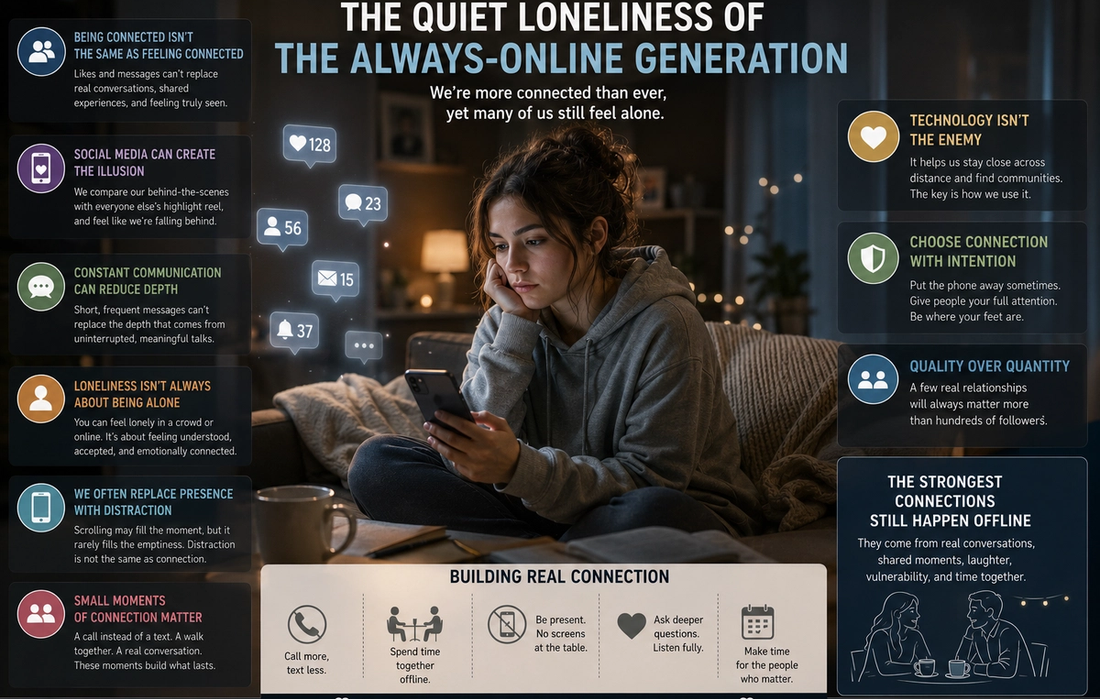
We have never been more connected.
With a few taps on a screen, we can message friends across the world, join online communities, attend virtual meetings, share photos instantly, and keep up with the lives of hundreds of people every day. Technology has made communication faster, easier, and more accessible than at any other point in history.
Yet despite this constant connection, loneliness remains one of the defining challenges of modern life.
For many people, especially younger generations who have grown up with smartphones and social media, loneliness doesn’t always look like isolation. It often exists quietly alongside endless notifications, busy group chats, and thousands of online interactions. It’s possible to be surrounded by digital conversations while still feeling disconnected in the moments that matter most.
Understanding this quiet loneliness isn’t about blaming technology. It’s about recognizing how the way we connect has changed—and why meaningful relationships still require more than an internet connection.
Being connected isn’t the same as feeling connected
Modern technology makes it easier than ever to stay in touch.
We can react to someone’s photo, send a quick message, or comment on a post in seconds. These interactions help us maintain contact with people we might otherwise lose touch with, and in many ways, that’s something worth celebrating.
The challenge is that frequent communication doesn’t always create emotional closeness.
A conversation made up of emojis, short replies, and disappearing messages can never fully replace the depth that often comes from spending uninterrupted time with another person. Real connection usually develops through shared experiences, honest conversations, and moments where people feel truly seen and understood.
Digital communication is valuable, but it isn’t always enough on its own.
Social media can create the illusion that everyone else is happier
One reason loneliness feels particularly difficult today is that we rarely compare ourselves with reality.
Instead, we compare ourselves with carefully selected moments from other people’s lives.
Social media feeds are filled with holidays, celebrations, career achievements, fitness milestones, and smiling group photos. Even though most people understand these platforms show only a small part of someone’s life, it’s surprisingly easy to forget that while scrolling.
When everyone else appears constantly busy, successful, and surrounded by friends, our own ordinary moments can begin to feel unusually lonely.
The comparison itself often creates emotional distance, even when nothing about our own lives has actually changed.
Constant communication can reduce meaningful conversations
Ironically, always being available doesn’t always strengthen relationships.
When conversations become continuous throughout the day, they often become shorter and more fragmented. We exchange updates, send memes, react to stories, and answer messages between meetings or while standing in supermarket queues.
These interactions help us stay connected, but they can also replace the longer conversations where people share how they’re really feeling.
Meaningful relationships usually grow through attention rather than frequency.
Sometimes putting the phone away and talking without distractions creates a stronger sense of connection than dozens of messages exchanged throughout the day.
Loneliness isn’t always about being alone
Many people imagine loneliness as physical isolation.
In reality, someone can feel deeply lonely while living with family, working in a busy office, or having hundreds of online contacts.
Loneliness is less about the number of people around us and more about whether we feel understood, accepted, and emotionally connected.
This is why someone with a large social media following may still struggle with loneliness, while another person with only a few close relationships feels supported and fulfilled.
Quality almost always matters more than quantity when it comes to human connection.
We often replace presence with distraction
Whenever life becomes uncomfortable, our phones offer an easy escape.
Waiting in line, eating alone, travelling on public transport, or sitting quietly at home rarely leaves much space for boredom anymore. Within seconds, we can scroll endlessly through videos, news, or social media.
While there’s nothing wrong with entertainment, constant distraction can quietly reduce opportunities for reflection, creativity, and spontaneous conversations with the people around us.
It can also make it easier to avoid difficult emotions rather than addressing them.
Sometimes loneliness isn’t eased by consuming more content—it is eased by reaching out to another person.
Small moments of connection matter
Building stronger relationships doesn’t always require dramatic gestures.
A phone call instead of another text message. A walk with a friend instead of chatting online. Eating dinner without screens. Asking someone how they’re really doing and taking the time to listen.
These moments may seem ordinary, but they often provide the sense of belonging that endless digital interaction cannot fully replace.
Meaningful relationships are usually built through consistent attention rather than occasional grand gestures.
Technology isn’t the enemy
It’s important to remember that technology itself isn’t responsible for loneliness.
For millions of people, digital tools strengthen relationships by helping families stay in touch across countries, allowing friends to maintain connections over long distances, and creating communities for people who might otherwise feel isolated.
The issue isn’t whether we use technology.
It’s whether technology becomes a substitute for the deeper forms of connection that human beings naturally need.
Like any powerful tool, its impact depends largely on how we choose to use it.
Choosing connection with intention
Living in an always-online world means meaningful relationships require more intentional effort than they once did.
Sometimes that means arranging to meet someone instead of simply reacting to their latest post. Sometimes it means putting the phone away during conversations, making time for family dinners, or choosing a phone call over another string of messages.
These choices may seem small, but they remind the people around us that they have our full attention.
And attention is one of the greatest gifts we can offer another person.
The strongest connections still happen offline
The digital world has made life more convenient, more informed, and more connected than ever before. It has allowed us to maintain relationships across continents, learn from people around the world, and communicate instantly in ways previous generations could only imagine.
Yet despite all these advantages, our deepest need hasn’t changed.
People still want to feel heard, understood, valued, and accepted. Those feelings rarely come from likes, notifications, or follower counts. They come from genuine conversations, shared experiences, laughter, vulnerability, and simply spending time together.
The always-online generation doesn’t necessarily need less technology. It needs more balance.
Because while the internet can connect our devices in seconds, meaningful human connection still happens one conversation, one shared moment, and one real relationship at a time.


AI
How AI Actually Works (No Math Required)

How to Spot AI-Generated Content Even When It’s Good

The Real Difference Between AI, Machine Learning, and Deep Learning

How to Prompt AI Like a Pro







Read More

Why the World Feels Faster Than Ever (And What to Do About It)
Astrid Jensen|
Why Some People Notice More Than Others
Joel Anderson|

Why the Slow Things Are Quietly Winning
Brett Crane|

How to Spend Less Without Feeling Deprived
Joel Anderson|

How to Spend a Sunday Like You Mean It
Brett Crane|

The Inventions That Changed How We Live (And Why)
Karina Leon|