
The Quiet Ways AI Is Already Changing Daily Life
C
By Celine Flynn on July 2, 2026
When most people think about artificial intelligence, they imagine futuristic robots, self-driving cars, or chatbots that can hold surprisingly natural conversations. Those technologies certainly attract attention, but they represent only a small part of AI’s impact. The biggest changes are happening much more quietly, often in ways we barely notice.
Artificial intelligence has gradually become part of everyday life, helping us complete tasks faster, personalize our digital experiences, and automate work that once required significant time and effort. Because these improvements have arrived little by little, many people use AI every single day without consciously realizing it.
Rather than transforming life overnight, AI is changing countless small moments. Individually, those changes may seem minor. Together, they’re reshaping how we work, communicate, travel, shop, and even make decisions.
AI is making everyday technology smarter
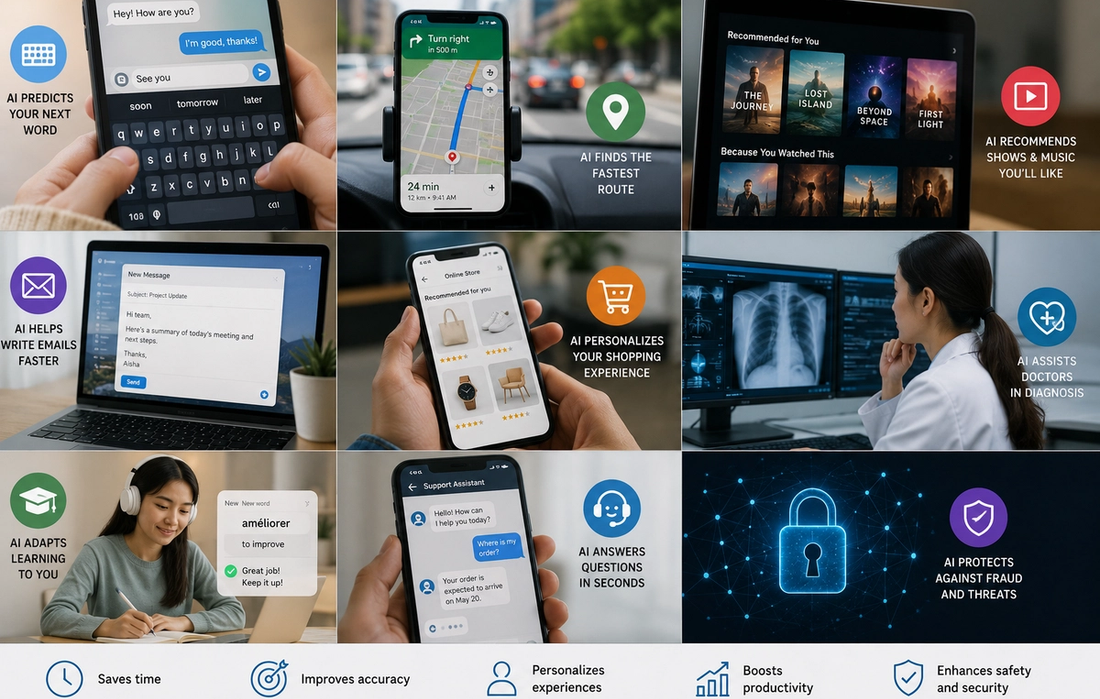
One of the most common places people encounter AI is on their smartphones. Every time your keyboard predicts the next word you’re about to type, your camera automatically adjusts its settings for better photos, or your voice assistant understands a spoken request, artificial intelligence is working behind the scenes.
Navigation apps also rely heavily on AI. They analyze traffic patterns, road closures, and historical travel data to recommend faster routes and estimate arrival times with impressive accuracy. Streaming services suggest movies and music based on your viewing habits, while shopping websites recommend products that match your interests.
None of these features feel particularly futuristic anymore because they’ve become part of everyday life. Yet they all depend on AI identifying patterns and making predictions in real time.
Work is becoming more efficient
Artificial intelligence is changing the workplace in ways that often go unnoticed.
Many professionals now use AI to summarize long documents, organize meeting notes, draft emails, generate ideas, translate languages, or analyze large amounts of information in minutes rather than hours. These tools don’t replace expertise, but they significantly reduce repetitive work.
Instead of spending valuable time on routine administrative tasks, employees can often focus on problem-solving, creativity, and decision-making. This shift isn’t about working harder—it’s about using time more effectively.
As AI continues to improve, it’s likely to become a standard productivity tool across a growing number of industries.
Shopping has become more personalized
Online shopping feels far more personal than it did a decade ago, and AI is one of the main reasons why.
Retailers analyze browsing habits, previous purchases, and customer preferences to recommend products that are more likely to be relevant. Dynamic pricing, personalized offers, and product suggestions are often generated automatically by AI systems that identify patterns across millions of customers.
While these recommendations can make shopping more convenient, they also remind us that AI is constantly learning from the choices we make online.
Understanding this helps explain why two people visiting the same website may see different recommendations based on their individual interests.
Healthcare is benefiting behind the scenes
Artificial intelligence is also making a growing impact in healthcare, although much of this work happens out of public view.
AI systems can assist medical professionals by analyzing medical images, identifying patterns in large datasets, supporting disease detection, and helping researchers develop new treatments more efficiently. Hospitals also use AI to improve scheduling, manage resources, and streamline administrative tasks.
Importantly, AI isn’t replacing doctors or nurses. Instead, it’s becoming a tool that helps healthcare professionals make faster and more informed decisions while reducing some of the routine work that takes time away from patient care.
For most patients, these improvements happen quietly in the background without changing the human relationship at the heart of healthcare.
AI is changing how we learn
Learning has become far more personalized thanks to artificial intelligence.
Language-learning apps adapt lessons based on your progress, educational platforms recommend content that matches your skill level, and AI tutors can explain difficult concepts in different ways until they make sense.
Instead of offering the exact same experience to every learner, many educational tools now adjust to individual needs. Someone struggling with mathematics might receive additional practice, while another learner moves ahead more quickly.
This personalized approach allows people to learn at their own pace, making education more flexible and accessible than ever before.
Customer service is evolving
Many businesses now use AI to answer routine customer questions, help users navigate websites, or provide support outside traditional business hours.
While automated assistants aren’t perfect, they often resolve simple issues much faster than waiting for a human representative. Questions about delivery times, account information, appointment scheduling, or product availability can frequently be answered within seconds.
For more complex situations, human support remains essential. The most effective customer service combines AI’s speed with human empathy and judgment, allowing each to focus on what it does best.
AI raises important questions too
Although AI brings many benefits, its growing presence also raises important conversations about privacy, fairness, employment, and transparency.
Many AI systems rely on large amounts of data to function effectively, which makes responsible data handling increasingly important. There are also ongoing discussions about ensuring AI systems are accurate, unbiased, and used ethically.
These conversations will become even more significant as AI continues expanding into new areas of daily life.
Understanding both the opportunities and the challenges helps people use AI more thoughtfully rather than simply accepting every new development without question.
The biggest changes are often the quietest
Unlike many technological breakthroughs of the past, AI hasn’t entered our lives through one dramatic invention. Instead, it has quietly improved thousands of everyday experiences.
It helps us find the fastest route home, organize our calendars, filter unwanted emails, recommend our next favorite song, enhance our photos, translate conversations, and complete routine work more efficiently. Most of these improvements happen so seamlessly that we rarely stop to think about the technology behind them.
That’s perhaps the most remarkable thing about artificial intelligence. Its greatest impact isn’t always found in headline-grabbing innovations or science fiction-like demonstrations. It’s found in the countless small ways it saves us time, reduces frustration, and makes everyday tasks just a little bit easier.
As AI continues to evolve, its influence will likely become even more integrated into our daily routines. And while we may not notice every individual change, together they’re gradually reshaping the way we live, work, and interact with the world around us.


AI
How AI Actually Works (No Math Required)

How to Spot AI-Generated Content Even When It’s Good
The Real Difference Between AI, Machine Learning, and Deep Learning
How to Prompt AI Like a Pro







Read More

Why the World Feels Faster Than Ever (And What to Do About It)
Astrid Jensen|
Why Some People Notice More Than Others
Joel Anderson|

Why the Slow Things Are Quietly Winning
Brett Crane|

How to Spend Less Without Feeling Deprived
Joel Anderson|

How to Spend a Sunday Like You Mean It
Brett Crane|
The Inventions That Changed How We Live (And Why)
Karina Leon|